I am sad to inform you of the death of Tom Donald from Fenwick, Ayrshire. Tom passed away on 15th July. He had been a member of V.S.M.A. since March 2003. Our condolences go to his wife Kim and family.
We welcome another new member since the last Newsletter – Chris Paton from Lanark. Many of you I’m sure will remember Chris from your rallying days. He was a great Mini enthusiastic and competed in EVERY Tour of Mull from the second event in 1970 up until 2009 when he had to retire his Mini. Have a look at his page to get full details of his motorsport career to date.
Database Changes:
A couple of amendments to members’ details – Alan and Audrey Carlaw have recently moved although still within the Glasgow area, while Rusty Wilson, Jimmy and Arlene McInnes have just changed their email addresses. Each of these changes can be seen in the Members and Details pages. On a similar note, if you have any change in your own details would you please let me know so that our database is up-to-date.
Highland Tour Outcome:
Members will be interested, I’m sure, in the letter below which Bob Baillie received from Gordon Clendinning following this year’s Highland Tour to Grantown-on-Spey.
Knockhill Classic Speedfair, 31st July :
Three of our girls “Sorting out the World” while waiting for customers in the Media Centre!
The Media Centre was manned once again as a “Cafe” for members at the one day Knockhill Speedfair. Unfortunately, it didn’t seem to be as popular with members as it has been in the past – numbers were well down this year! Apart from the usual “Staff” (Bob and Margaret Baillie, Adele and Duncan Paterson, Andy and Fiona Watson, Stuart and Mairi Parker), there was only a handful of members turned up on the day. Next year?
Veterans still competing :
I am delighted to display a photo of a couple of our members who are still actively competing – and doing pretty well at it! At the famous Annual Shelsley Walsh Hill Climb on 23rd July, Alan Macvarish and Malcolm Wishart were both competing.
Malcolm Wishart and Allan MacVarish taken at Shelsley Walsh Hill Climb on 23 July 2011. Allan was in a Modified Production up to 2 litres Class and was driving his Peugeot 205 Gti – best time 40.52 secs., while Malcolm was in the Racing Cars manufactured up to 1971 Class in a Cooper T65 FJ and his best time was 38.34 secs. Not bad for two of our veterans.
Also flying the VSMA flag were Olly Ross and Kenny Allen. Kenny was at the Knockhill Speedfair on 31st July. Despite being shunted off in an earlier race he was 4th in the 2nd race in his Lotus Elan , while Olly was 4th in his Lotus Europa in the Scottish Classic Sports & Saloon Classes A & B.
Documents from the Archive:
Gus Carnegie kindly sent a copy of his menu of the 1969 SMRC Annual Dinner Menu which will be of interest to our racing members.
Cover of 1969 SMRC Annual Dinner and Prezentation of Awards ProgrammeInside of the 1969 SMRC Annual Dinner & Presentation of Awards Programme.
Additional photos:
Members are slowly sending in photos pertaining to their involvement with Motor Sport, some thankfully also sending recent photos of themselves (helps others not just to see who they are but to see how time has dealt with them)! I would love to receive more to display on members pages. I recently received three images of the late Stuart Brown and myself in the 1968 and 1971 Scottish Rallies. I’m afraid I don’t know the others in the photos apart from Stuart and myself – can anyone help?
Picture Puzzle:
These images below were sent to me by a Jake Butson (not a VSMA member) to use on our site if we wished. The only information he could provide was that they were from possibly the ’60s and taken at The Rest and Be Thankful and possibly at Gask. Can anyone give me any further info? The date or year? Which event? Who might be competing in what car? etc. If I had more information I might be able to put a couple in the Public Gallery.
Due to extended holidays, it is just a very brief Newsletter this month. Firstly may I welcome to the Association Geunda Young who lives in the Isle of Islay. Geunda was formerly Geunda Eadie started her motorsport career in Scotland but competed mainly in England. She was the Faberge champion in 1979 and a BTCC competitor in 1980 in a works Ford. We look forward to more details (and images) of her career later.
I have some very sad news to report – Bill Syer has died on 7th June, 2011, after a prolonged illness. You can if you wish, view his obituary in thePast Veterans section.
Knockhill Classic Speedfair – Sunday 31st July
This Sunday – we can again be found in the Media Centre at Knockhill from 10 am so please drop in for a chat, a seat and non-alcoholic refreshments. We have been allocated a parking area for our members in the gravel area (on the left as you drive towards the top gate, beside the Kart Centre). If you intend coming, let me know soon and I will send you a Car Park sticker.
More information on the event itself is available on the Knockhill website.
Really not much to report since the last newsletter but here are the items of News –
Monte Carlo Rallye Historique
Death of Members
Members’ Database changes
Dates for your Diary
Infiniti Support Our Paras Racing
YouTube Clips
Amusing Bits and Pieces
Monte Carlo Rallye Historique:
About a couple of weeks after the Glasgow start of the Monte Carlo Rally, I received an email from Member Neil Barrington to the effect that he had just returned from Monte Carlo having taken part in the team supporting an Alpine Renault 110, No.115. They had started from Reims in northern France and headed south. This was, of course, the Monte Carlo Rallye Historique event, but was amazingly arduous and long over 4.5 days and covering 3,500 miles since leaving Edinburgh. Neil had no experience of this event before and was very impressed with the organisation of it and the very high regard that it endears, with scores of locals out watching at 3 in the morning. The scoring and penalty system was news to him, as he was more accustomed to the special stage approach rather than “regularities”, which require average speed rather than “balls out”!!
It was very exciting and difficult with many roads covered in snow and very very steep and precipitous, plus staggering drops into ravines if you got it wrong. He met another VSMA member, Chris Paton down there, who was an old adversary on the Tour of Mull. At least now he can say that he had personally driven around the GP circuit, even if it was in a service van complete with trailer!
This meeting with Chris Paton leads me on to Chris’s account, as he too was servicing a Mini Cooper S on the same event. Chris has sent a full report on his “adventure” on the event, complete with many photographs including details of how the event was organised. Although it is not a “Tale from the Past“ that is where this report can be found. Have a look – it is really worth a read.
Just a few pics from Chris’s Report
Death of Members:
I’m sad to report that John Falconer died on 7th March 2015. John was well known to Lanarkshire Car Club members.
Member’s Database Change:
We received an email from Ronnie Morrison recently to say that he had had to take action against nuisance telephone calls. He was obliged to block ALL calls which had withheld their number! To get over this, he asked if you would amend your phone book by putting 1470 first before his number. This should then allow you to get through to him.
Dates for your Diary:
VSMA Reunion 2016 – Although early days, I am delighted to report that our next Reunion will be held in 2016, on Friday 14th October. Due to the popularity of the Radstone Hotel just of the M74, we have booked at as our venue once again. There are lots of decisions to be made before that date – who will be our sponsors, our guests, the format, etc, etc. I will let you know the outcome of these as the months’ pass.
Bo’ness Hill Climb: The Bo’ness Hill Climb Revival will be celebrating their 8th Revival meeting on 5th and 6th September 2015. This will be the 81st anniversary of the first ever Hill Climb at Bo’ness in 1934. We will be there again. Find out full details for downloading from their website at www.bonesshillclimb.org.uk
The BHCR are keen to have a word with any of our VSMA members who had competed on the hill prior to the enforced reduction to its present length. There is word afoot that a TV programme, about the history of Bo’ness Hill Climb, is being created and it is hoped to interview anyone who took part in the event using the ‘old’ hill. So, if you fall into this category would you please get in touch with Barry Crichton who is a member of the BHRC Committee who will give you details of what is happening. (Mobile: 07928 629388 or williamcrichton@sky.com)
Infiniti Support Our Paras Racing – ready for BTCC 2015 –
The Infiniti Support Our Paras Racing Q50 that will be used in the BTCC for 2015
This year’s BTCC teams are unveiled to the public next week – among them a striking Infiniti with an eye-catching roof. It is the Infiniti Support Our Paras Racing (ISOPR) car prepared by injured vets and, by year three, according to team principal Derek Palmer, from Lesmahagow, Lanarkshire, it will be driven by an injured soldier. The car roof reflects the Paras’ beret and badge. And it is no gimmick. “We will have podium finishes in our first season,” predicted Derek. “By year two, we will be winning races on a regular basis. It is a brand new team driving a brand new car and it will not be easy, but the work ethic and the discipline of these guys is amazing. This car and this team can one day win the championship.” This season, ISOPR will have two cars racing in the BTCC in a project brought together by Derek and his friend, Colin Smith, formerly the boss of the Afghanistan Trust – now renamed.
The roof showing what the aim of Support Our Paras was.
The aim is twofold – to raise the profile of the charity and, in the longer term, to raise cash for wounded servicemen and their families. Derek agrees his support team has little experience but their commitment is so intense that he is completely sure of himself. He went on: “Working with these guys makes you feel quite humble. These guys have issues that would make you think twice about getting out of bed in the morning – and yet it’s not an issue. “If one can’t tighten something with his right hand because he doesn’t have one, someone else steps in and does it and just walks away. It’s incredible.This team is not like other teams, it is not about the driver, it is about everyone working together and that makes it very special.”
The cars they are using are Infiniti Q50s but totally different from the road car. The only thing they share is the 2.0-litre turbo direct injection engine. The first race is at Brands Hatch on the weekend of April 4 and 5, when both cars will have to be ready.
The Infiniti Support Our Paras Racing Q50 that will be used in the BTCC for 2015
It is a fairly short timescale for a new team to get in harness and it means that the Support Our Paras guys will be working right up to the last second. “But we should be good to go,” said Derek.
To help prepare, the ISOPR team visited the Infiniti Red Bull Racing F1 team at their factory in Buckinghamshire. The team had a behind-the-scenes tour and met staff from various departments, with an emphasis on race prep.
They spent time with the Red Bull F1 pit crew — who showed the Paras team how crucial meticulous teamwork is in Red Bull being able to replace four wheels on an F1 car in under three seconds — and had a session in the Red Bull gym.
The Infiniti Support Our Paras Racing took the opportunity to learn from the masters.
The guys were shown a series of exercises — all adapted to cope with their numerous injuries — to help them maintain a high level of fitness for the challenging 10-weekend, 30-race BTCC season. “I had to keep pinching myself today,” said former Paratrooper Mike Lewis, injured in Afghanistan after two deployments in Iraq.
“I’ve watched the Infiniti Red Bull Racing guys change tyres on the Formula One car for years on the TV, and today I not only watched them in action but worked alongside them.It’s been a privilege. These guys are the best at what they do – of that there is no question.Sure, we don’t need to carry out pit-stops in the BTCC, but we’ve all learned so much today about how important it is to work as a unit and as a team.”
The Infiniti Support Our Paras Racing Q50 that will be used in the BTCC for 2015
At present, there are eight injured Paras working off and on but the plan is for all of them to work full-time on the car. Derek’s son, also Derek, will drive one car this year and Richard Hawken will take the wheel of the other and the team will learn as they go.
Derek said: “This is not just for these guys, this is for all the guys who have been pensioned off, who have been injured and know what it’s like. It’s for them as much as us.”
Some Amusing Bits and Pieces:Here’s three from our dear leader……..
“4 Worms In Church”
Four worms and a lesson to be learned!!!!
A minister decided that a visual demonstration would add emphasis to his Sunday sermon. Four worms were placed into four separate jars.
The first worm was put into a container of alcohol. The second worm was put into a container of cigarette smoke. The third worm was put into a container of chocolate syrup. The fourth worm was put into a container of good clean soil.
At the conclusion of the sermon, the Minister reported the following results:
The first worm in alcohol . . . . . . . . . . . . Dead. The second worm in cigarette smoke . . . Dead. Third worm in chocolate syrup . . . . . . . . Dead. Fourth worm in good clean soil . . . . . . . . Alive….…
So the Minister then asked the congregation, “What did you learn from this demonstration?”
Maxine, sitting in the back, quickly raised her hand and said . . . .”As long as you drink, smoke and eat chocolate, you won’t have worms!”
That pretty much ended the service!
——————————
The Jewish Samurai
Once upon a time, a powerful Emperor of the Rising Sun advertised for a new Chief Samurai. After a year, only three applied for the job: a Japanese, a Chinese and a Jewish Samurai.
“Demonstrate your skills!” commanded the Emperor. The Japanese samurai stepped forward, opened a tiny box and released a fly. He drew his samurai sword and *Swish!* the fly fell to the floor, neatly divided in two!
“What a feat!” said the Emperor. “Number Two Samurai, show me what you do.”The Chinese samurai smiled confidently, stepped forward and opened a tiny box, releasing a fly. He drew his samurai sword and *Swish! Swish!* The fly fell to the floor neatly quartered.
“That is skill!” nodded the Emperor. “How are you going to top that, Number three Samurai?”The Jewish samurai, Obi-wan Cohen, stepped forward, opened a tiny box releasing one fly, drew his samurai sword and *Swoooooosh!* flourished his sword mightily, but the fly was still buzzing around!
In disappointment, the Emperor said, “What kind of skill is that? The fly isn’t even dead.” “Dead?” replied the Jewish Samurai. “Dead is easy. Circumcision…THAT takes skill!”
——————————
And finally, some from our Leader, which might raise a smile from your grandchildren….!
I bought my wife a wooden leg for Christmas! It’s not her main present, just a stocking filler……
Two Aerials meet on a roof – fall in love – get married.The ceremony was rubbish but the Reception was brilliant……..
Two women called at my door and asked what bread I ate, when I said white they gave me a lecture on the benefits of brown bread for 30 minutes. I think they were those Hovis Witnesses………
Just had my water bill of £175 drop on my mat. That’s a lot. Oxfam can supply a whole African village for just £2 a month! Time to change supplier I think………
A mummy covered in chocolate and nuts has been discovered in Egypt. Archaeologists believe it may be Pharaoh Roche……..
My friend just hired an Eastern European cleaner, took her 15 hours to Hoover the house. Turns out she was a Slovak……..
Since the snow came, all the wife has done is look through the window. If it gets any worse, I’ll have to let her in……….
Interesting YouTube Clips:
Just a few, which are best viewed in ‘Full Screen’ and maybe with the sub-titles on.
This is an earlier Newsletter than I had intended but as I had received numerous bits of information and photographs I felt it was right to get it to you before it became too out of date. I have received numerous photographs from people who were at this year’s Spring Run to Grantown-on-Spey. The report on this run will be able to be seen in the “Previous Event” section – but not yet! I will let you know when it is available.
Can I remind you that all the images within this Newsletter (and all previous ones) can also be viewed in the “Picture Gallery” by the various methods of searching.
Malcolm Parkin seems to have set memories alight and caused some cross-member discussion. However, peace seems to have settled – read below.
Address changes –
Our Gordon Brown (not the political one) has moved to West Kilbride. His new Address and phone numbers can be found in the “Members and details” section.
Here are some of the other items of news this month –
Interesting Stuff from Members
The 6th Flying Scotsman, 4th to 6th April 2014
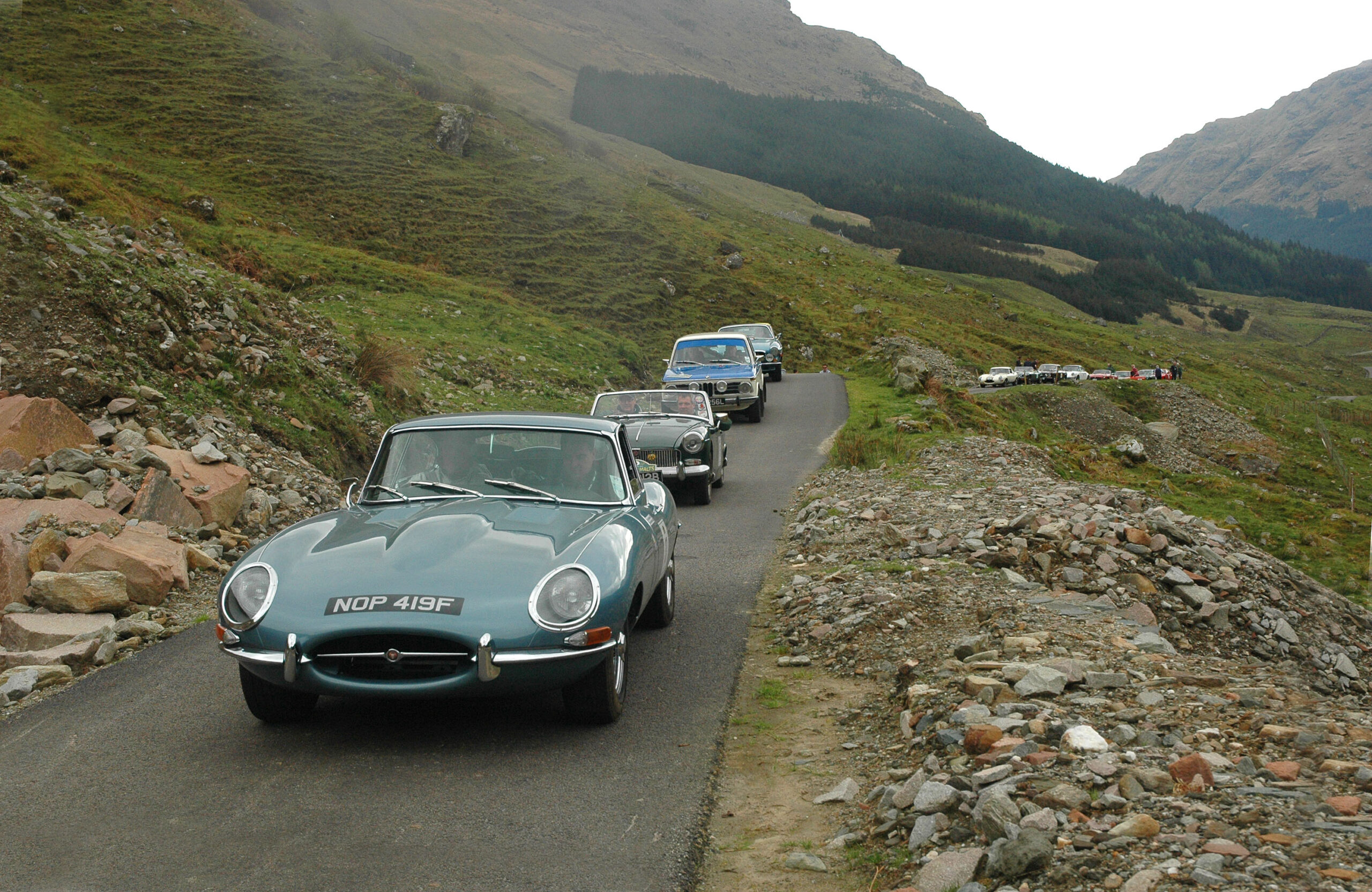
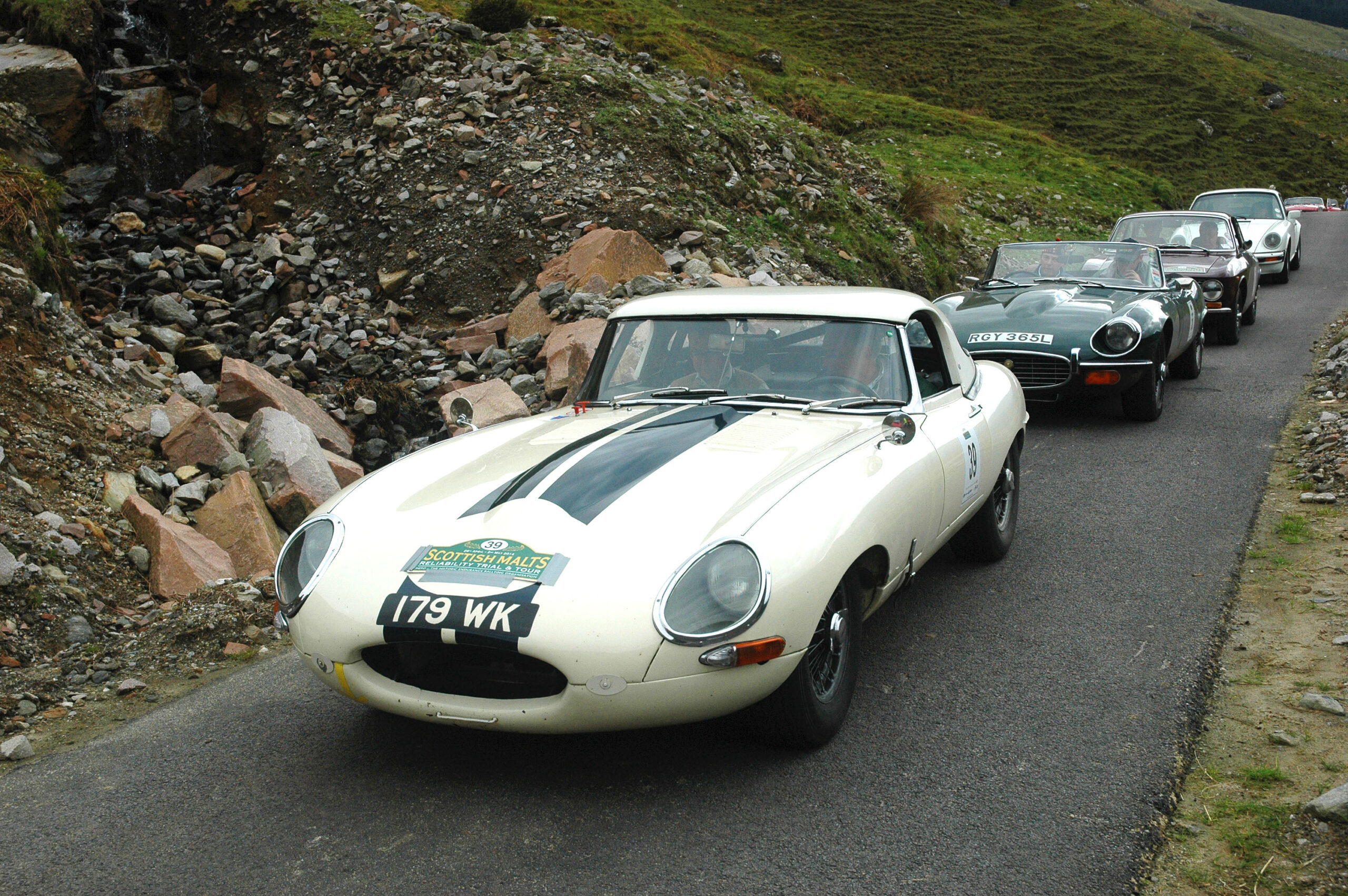
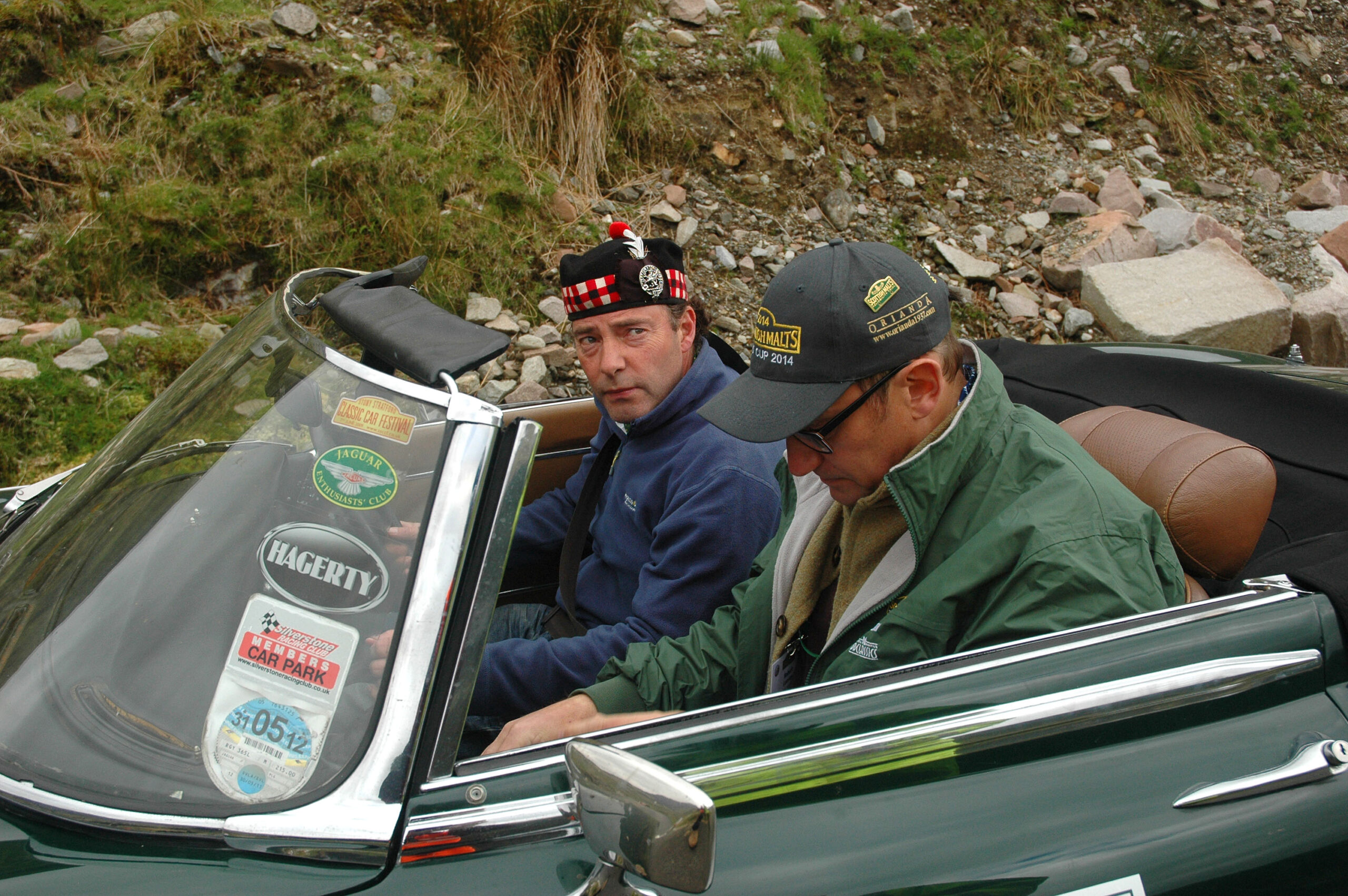
Scottish Malts Classic Tour – 28th April to 2nd May 2014
More on the “Thoughts from Malcolm Parkin”
Interesting YouTube clips
Bits and Pieces which may amuse
Interesting Stuff from Members:
Brian Harrison: Got an email from Brian which will be of interest. You may recall that the HaldaneHD-100 and HD-300’s cars were manufactured in East Kilbride during the 80’s and 90’s, the company was run by Brian Harrison and Alasdair Scott. Actually, one of the last HD-300’s made is now stuck up on the wall in the Glasgow Transport Museum! Recently he was contacted by an enthusiast/owner in Holland and asked to contribute details of the history of Haldane Developments for a website the Dutchman was producing. Have a look at the ‘History’ and ‘Register’ chapters at this site www.haldane.nl to get the story behind the Haldane’s production, etc. This is an excellent effort and makes interesting reading. Isn’t it amazing just how many of these cars have survived and are still enjoy an active life !
With more family and business responsibilities, Brian retired from racing in 1975 and took up something less expensive and less dangerous ………………………. Hang-Gliding.! Check out Brian’s own site showing now his involvement in gliding. His present company is X-C Aviation where he is currently working on the development of an electric powered glider with a company in Poland. Changed days!Brian had over 7 years direct involvement in motorsport, 7 years in Haldane Developments and 8 years in Karting with his son Kenneth, during which time he also developed an award-winning performance logging system for karts and race bikes under the name Datalap Racing Systems. Karting at that time was full of fathers who were co-competitors of his and several friendships were renewed including with Jimmy Sime who is currently finishing the rebuild of his original 1970’s Mini and is about to go racing again! As he said, “once a competitor, always a competitor, I guess!”
Willie Crawford:
Got an email from Willie including the photographs below for inclusion. He mentioned that “Funnily enough since I retired some years ago I have satiated my desire to fly around the place on four wheels by having a part-time job driving a small car transporter, collecting and delivering hire cars all around Scotland. Does not pay much money but keeps me happy….”
Eric Dymock:
Eric emailed to say that he was recently celebrating his 80th birthday! Also, he attached the couple of photographs below which he had received from Andy Morrison. This shows Eric competing in the 1964 Scottish Rally with Graham Birrell as his co-driver in a borrowed Works Cortina.
The 6th Flying Scotsman, 4th to 6th April 2014 –
Organised by the Endurance Rally Association. The event this year, which was a Vintage Reliability Trial, broke with tradition and moved further north. Starting at the Forest of Arden which is near Birmingham, the Competitors drove north into Lancashire and Yorkshire on the first day. On day two they moved into Scotland finishing at the Gleneagles Hotel on day three, having driven much more on Scottish roads than in previous events. To be eligible the cars had to have a pre-war chassis and a pre-war engine design. However, they did allow an HRG, which was essentially a pre-war car, and an MG T-Type as it had two leaf springs at the front. It was a Regularity Road Rally with off-the-public-road time trials. There were 98 starters, of which 94 managed to finish which is quite remarkable considering the age of these vehicles. Again the vast majority were from Great Britain (61) but there were entries from Ireland (5), Holland (8), Switzerland (2), Germany (4), Belgium (7), Luxembourg (2), Spain (2), Canada, USA (3) and Australia (1). Have a look at the ERA website to see the huge variety of vehicles entered. The photographs below are only a few of the ones taken at the control near Carron. Again we are grateful to Bill Barr who sent in these photographs of himself and Harry Merry still doing their bit for Motor Sport as Marshals at that Time Control.
These Photograph below are with the courtesy of Bill Barr
Scottish Malts Classic Tour – 28th April to 2nd May :
This was an event run by the Classic Endurance Rallying Organisation. They have been running this particular event annually since 2007 tending to be based in places like Gleneagles or Turnberry, as well as visiting a number of whisky establishments en route. I must admit it was the first I had heard of this event. Bill Barr and Harry Merry were both involved in manning the Rest and Be Thankful section. Having just finished their stint with the 6th Flying Scotsman Rally, and having been involved with running events in Scotland for many years, they were not amused by the dreadful organisation at the Rest. Anyway, Bill sent these photos he took on the Rest for your interest. For those who would like more detail of this organisation click here.
More on “Thoughts from Malcolm Parkin“ from the April Newsletter:
What a flurry of emails following “Malcolm’s Thoughts” in the last Newsletter! Here is a précis and hopefully a conclusion to what has turning out to be a bit of a saga. Interesting none-the-less…..!
Extracts from Emails
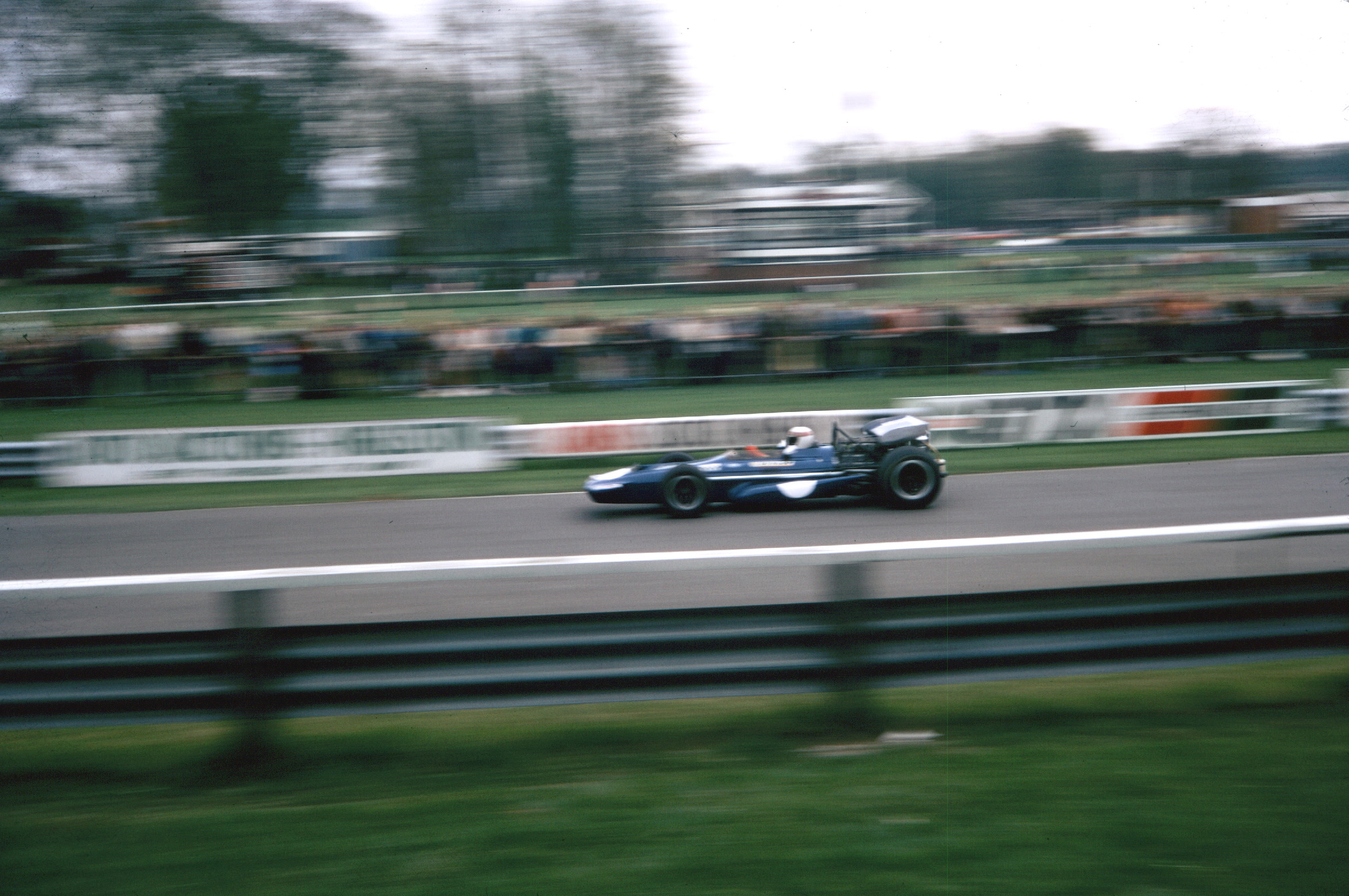
21 April, 14.34 hours Donald MacDonald emailed to state that “regarding JYS’s demonstration of Tyrrell 003 at Ingliston, features (with photographs) on page 90 of Graham Gauld’s book ‘Scottish Motor racing and Drivers’ and according to the report, the August meeting was in 1978.”
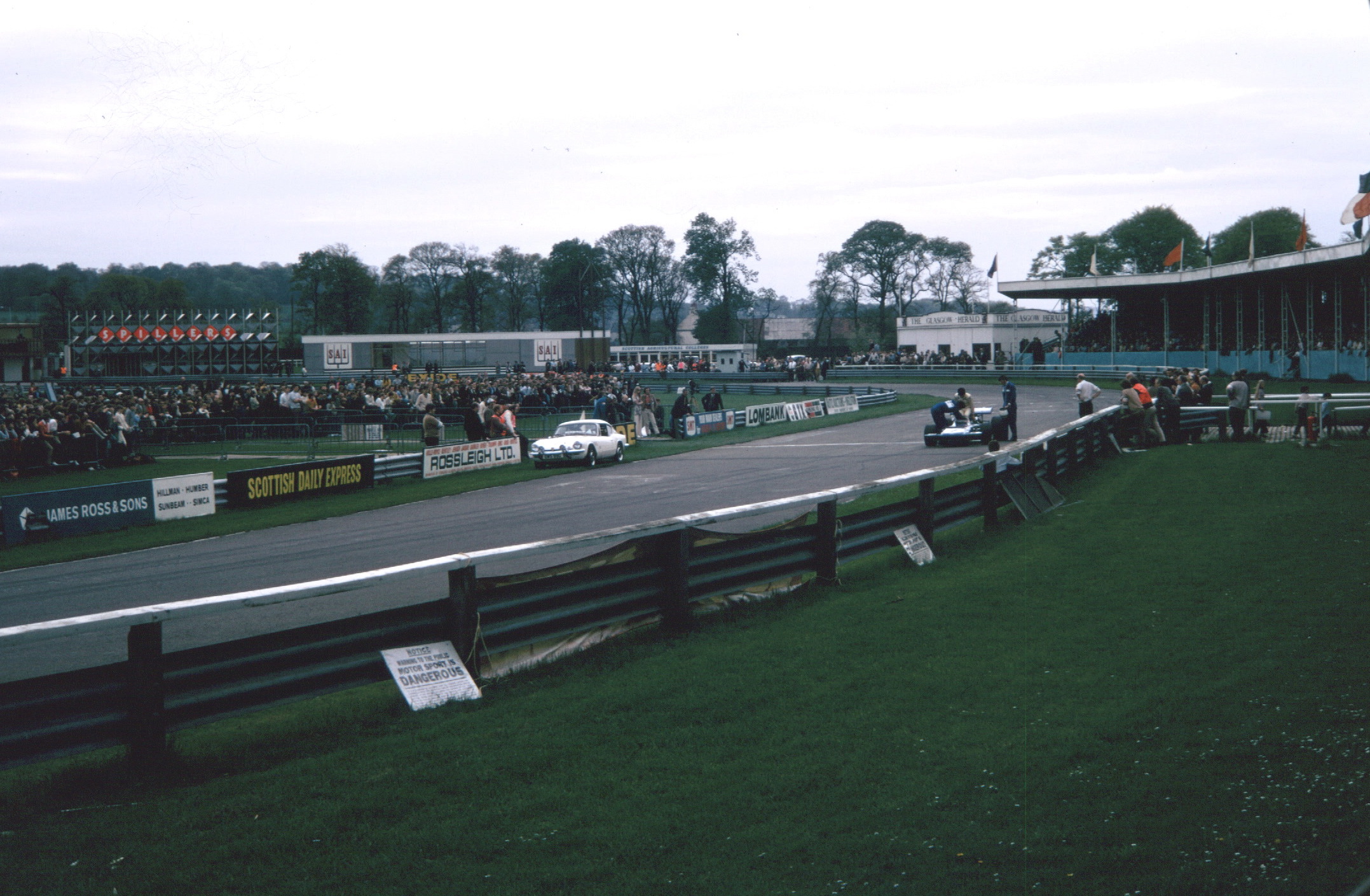
30th April, 23.35 hours Iain Nicolson from the Ingliston-circuit website wrote: “I was interested to read Malcolm Parkin’s thoughts in the recent VSMA members newsletter of Jackie Stewart bringing his Tyrrell 003 up to Ingliston on a demo. He suggests that it may have been in 1971, and that may have been so, however, I can vouch for the fact that JYS did indeed bring Tyrrell 003 up to Ingliston for the August 1979 meeting – and I also had the sense to take some photos (although surely others did too?). A couple of these are onmy website but I’ve also attached a few more to this email, for your enjoyment…”
1st May, 9.58 hours Malcolm Parkinresponded to Iain as follows: “Many thanks for that 1979 information about Tyrell 003. Jackie Stewart has demonstrated twice at Ingliston, and the earlier occasion – which is the one I was thinking about – was 1969 when he demonstrated the Matra Cosworth F1 car, in which he won his first world championship. The engine was fluffing due to a mixture problem, and he stalled the car while doing a racing start in front of the grandstand, much to his embarrassment. He later went on to give a tremendous drive, and it was interesting to note that he was still accelerating round the left-hander at Clock, leaving his braking to the entry point at the right-hander before the grandstand. Very impressive! The Clerk of the Course on the day as I recall was the late Ernie Herrald.”
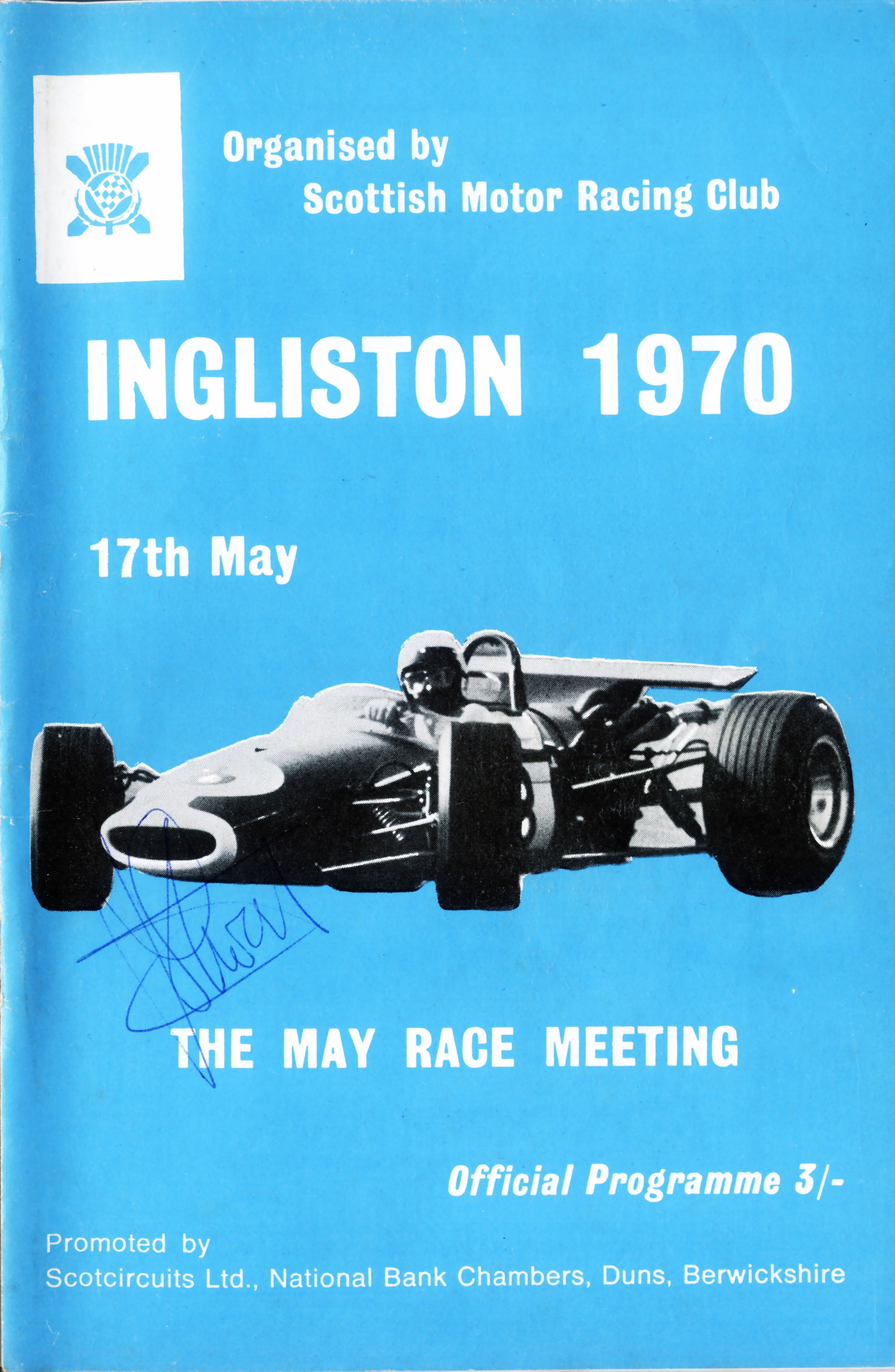
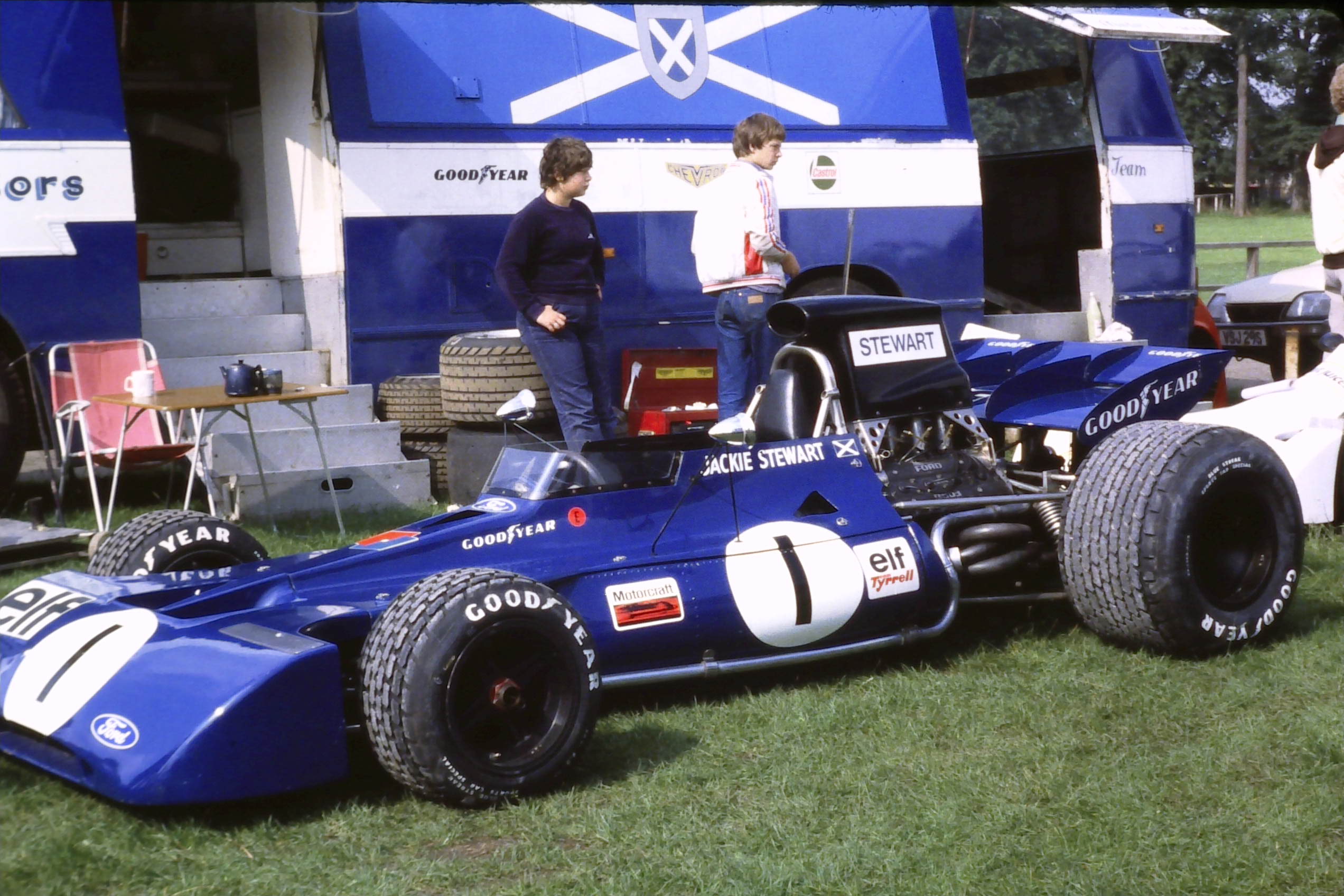
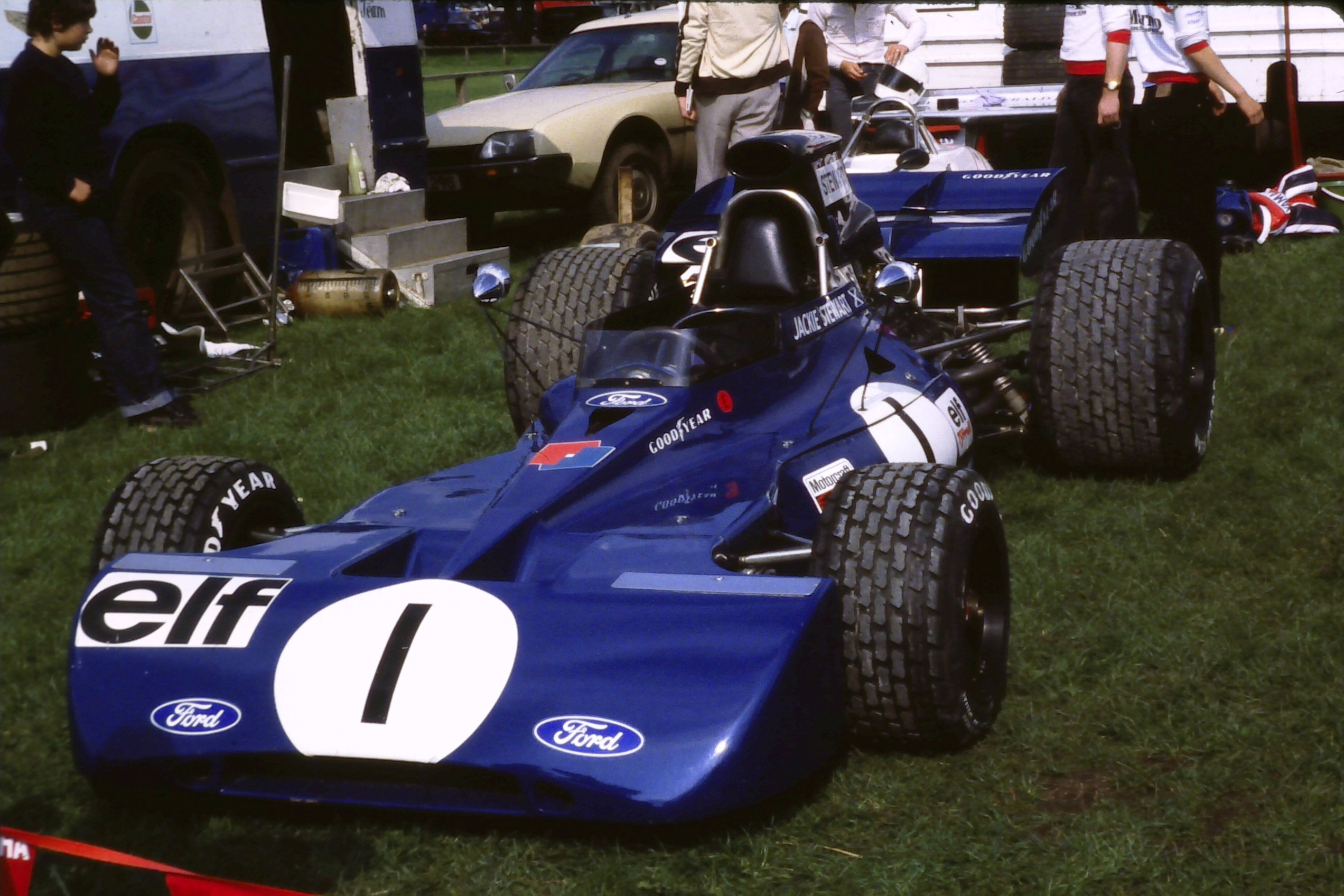
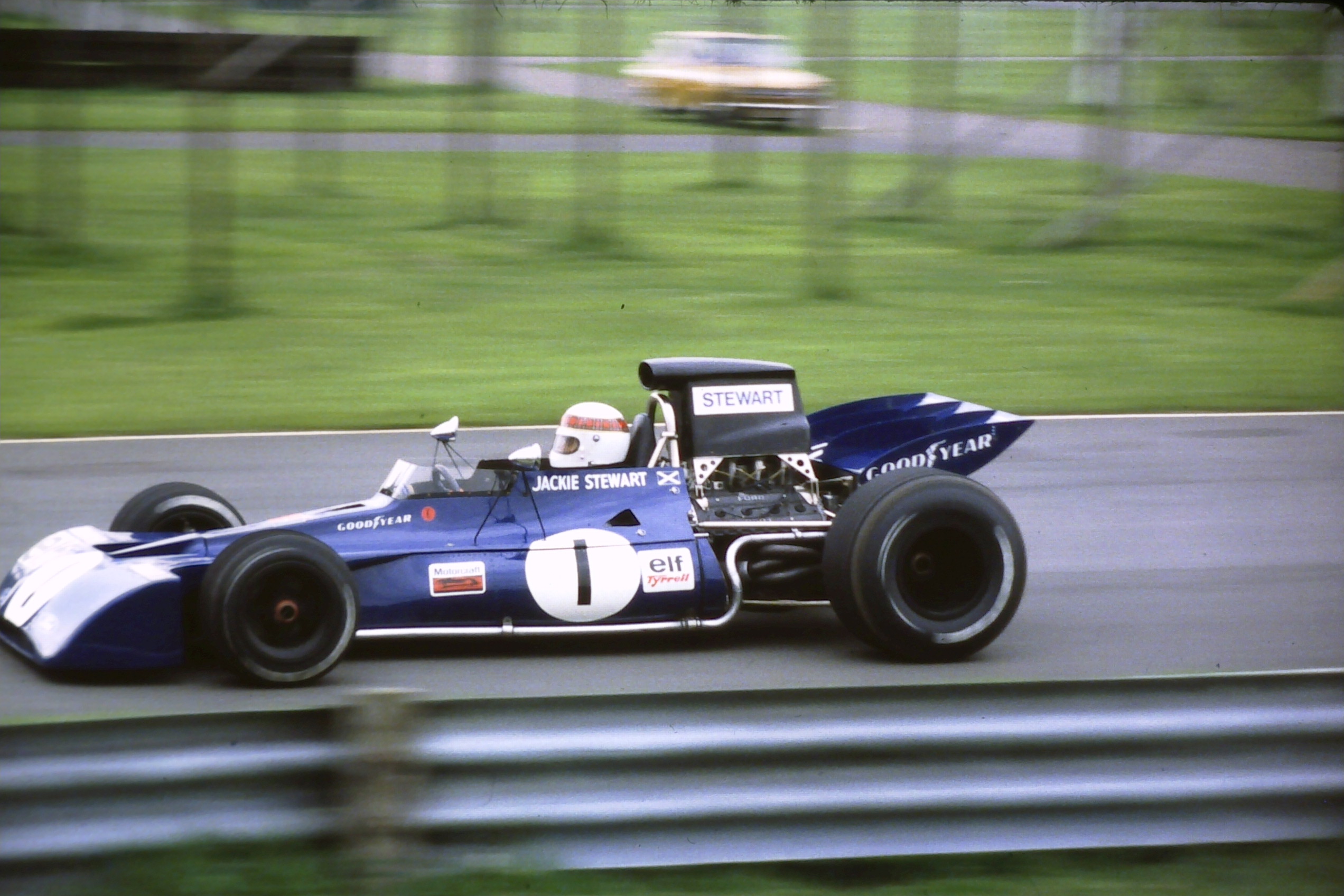
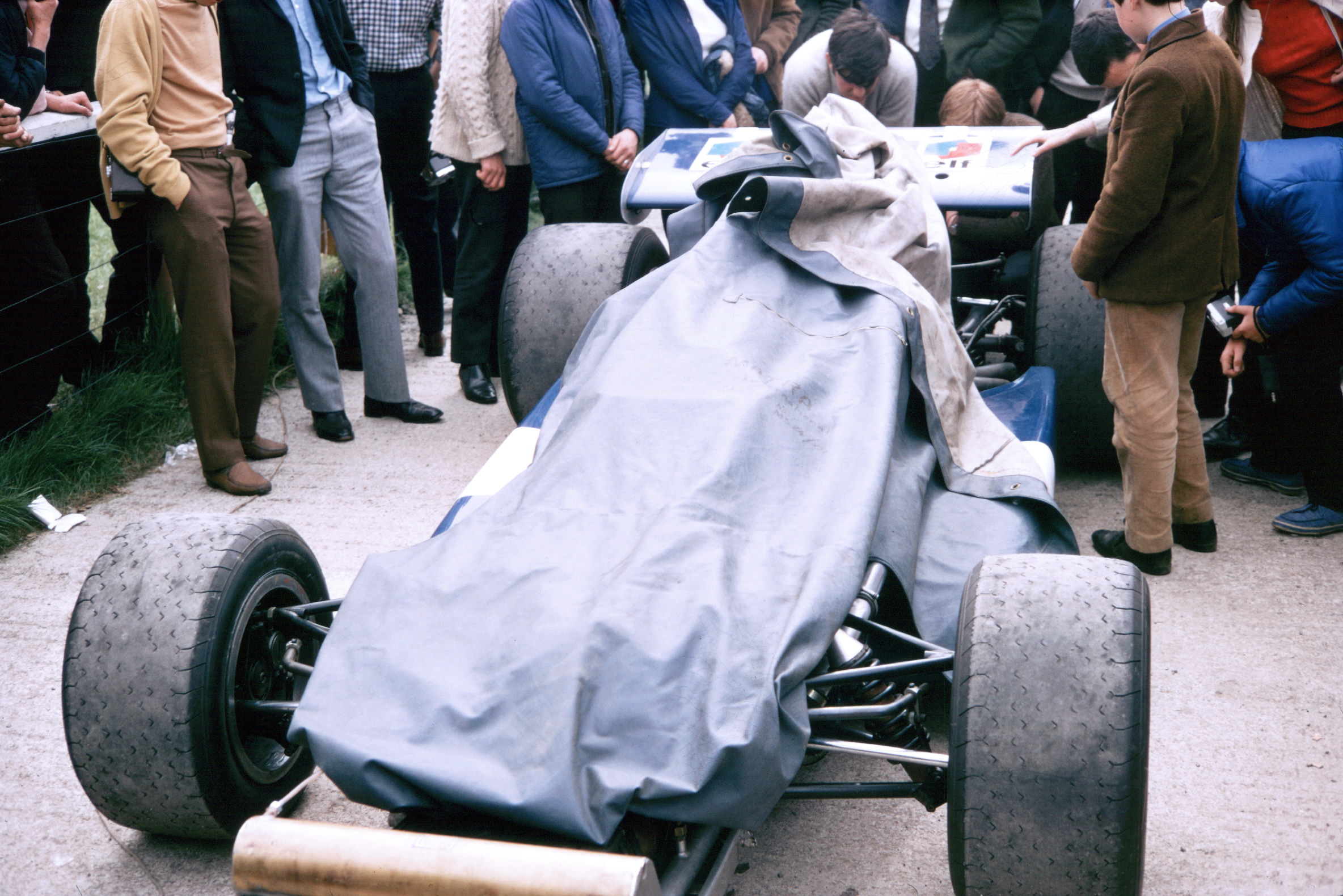
1st May, 15.23 hours Iain Nicolson responded: “Aha, this is getting interesting! I’m not sure you are entirely correct about the date and the car Malcolm. Jackie Stewart did demo his March-Cosworth (not the Matra in which he won the championship) at Ingliston at the May 1970 meeting – see photos attached, including my autographed programme cover! As you see below, the car was covered up in the paddock before I managed to get my photos, presumably because this was a current Grand Prix car at the time, which Jackie was actually racing that season, and so perhaps they didn’t want it to be seen too closely…?! Correct me if I’m wrong, but to the best of my knowledge the Tyrrell Matra-Ford was never demonstrated at Ingliston.
1st May 17.38 hours
Malcolm in reply to Iain: “Well, I think you could be correct! I am copying this into my good friend Douglas Thomson who had it as the Matra in 1969. Doug also mentioned to me that Tyrrell used the March chassis in 1970 until they could develop their own car. What a game of trivial pursuit I have started, except it isn’t trivial! Douglas, would you like to comment please?“
1st May, 20.57 hours Douglas Thomson reply:“Oh dear, oh dear, curious and more curious!! The car in the photograph is unmistakably a March 701, the driver is unmistakably Jackie Stewart, and the track is unmistakably Ingliston. That would make it early 1970 because the Tyrrell 001 first appeared at the Gold Cup non-championship Formula One race meeting at Oulton Park sometime in the Summer of 1970, and the March chassis was abandoned after that. Tyrrell, of course, ran the Matra chassis in 1969, powered by a Cosworth DFV engine, and Stewart won the World Championship that year. The Tyrrell team wanted to continue using a Matra chassis in 1970, but Matra insisted that if Tyrrell wanted their chassis, they also had to run Matra’s own V12 engine which was heavier and underpowered compared to the DFV. As Tyrrell and Stewart were committed to using the (Ford) Cosworth DFV engine because a lot of their money came from Ford, the team were forced into running a customer March 701 chassis for the start of the 1970 season, until they could get their own car up and running. I think I am right in saying that Stewart was the only person to win a Grand Prix in a March 701, the Spanish GP if my memory serves me right, although you might want to look that up. However, I am glad to see that all the pieces of the jigsaw are gradually coming into place.”
2nd May, 09.53 hours Douglas to Malcolm : “Shortly after sending off the e-mail to you last night, I had a phone call from my photographer friend Eric Bryce who went to most of the Ingliston race meetings. He said he had found a photograph he took of Jackie Stewart at Ingliston with the March 701 in 1970, but no record of Stewart being there with the Matra in 1969. That would tie in with the photos you e-mailed to me yesterday. So it seems I was quite wrong about the Matra, and I am very sorry for sending you off on the wrong tack with that possibility. The facts seem to be, therefore, that Jackie Stewart’s two visits to Ingliston to demonstrate a Formula One car were in 1970 with the March 701, and in 1979 with the Tyrrell 003″.
2nd May, 10.13 hours Finally, Malcolm replies: “After some clever investigation, and thanks to Iain’s eyewitness, photographs, and autograph, we have clarified the position with Sir Jackie’s Ingliston demonstrations.“
Editor: Well done if you have got as far as this. We know now who we could have in our Pub Quiz Team…….. or maybe not!
Interesting Youtube clips:
Just a few, which are best viewed in ‘Full Screen’
A quite topical and amusing advert from France for the use of paper
The children were lined up in the cafeteria of a Catholic elementary school for lunch. At the head of the table was a large pile of apples. The nun made a note and posted on the apple tray: ‘Take only ONE. God is watching.’ Moving further along the lunch line, at the other end of the table was a large pile of chocolate chip cookies. A child had written a note, ‘Take all you want. God is watching the apples….’
A Sunday school teacher was discussing the Ten Commandments with her five and six-year-olds. After explaining the commandment to ‘honour’ thy Father and thy Mother, she asked, ‘Is there a commandment that teaches us how to treat our brothers and sisters?’ From the back, one little boy (the oldest of a family) answered, ‘Thou shall not kill.’
Shampoo Warning
WARNING TO US ALL – YOU NEED TO READ THIS
I don’t know WHY I didn’t figure this out sooner! I use shampoo in the shower when I wash my hair, the shampoo runs down my whole body, and printed very clearly on the shampoo label is this warning,
“FOR EXTRA VOLUME AND BODY”
No wonder I have been gaining weight! Well, I got rid of that shampoo and I am going to start showering with Palmolive dish-washing liquid instead because of its label reads
“DISSOLVES FAT THAT IS OTHERWISE DIFFICULT TO REMOVE.”
This is the story of the first and only rally I have done in a communist country, and it was at the height of the Cold War to boot. It was also one of the best, certainly the most gruelling, and superbly organised. Chris Watham from Southampton was the driver, and yours truly occupied the hot seat. Our car was an ex-works Group 1 Mark 1 Escort prepared by David Sutton and entered by Cal Withers, so at least we had everything going for us so far as the means of propulsion was concerned.
My memories of the event started on board a Balkan Airways Tupelov at Brussels. I sat with Castrol’s world troubleshooter whose name I regrettably can’t remember; but he was a fine fellow who knew a lot about the world as he went through a ninety-page passport nearly every year! One of his many briefs was to see that Castrol-sponsored motor sport events reflected well on his company, which was the reason for his trip to Bulgaria.
Take-off seemed to be a ponderous and lumbering affair, and I commented on this. “Well,” said my companion, “They’re not Rolls Royce engines are they?” He also pointed out the general configuration of the ‘plane, which I saw could be converted into a troop carrier very easily.
“Here’s your first dose of communism coming up”. This took the form of what looked like a hatchet-faced discus thrower who asked us if we wanted tea or coffee. Svelte she was not. I wanted coffee, my friend wanted tea. She duly returned with a tea bag and a jar of instant coffee from which she carefully spooned some of the vile stuff into my plastic cup. She then asked if we wanted sugar or milk, trotted off, and returned with our order. The punch line came when she once again returned to our seats bearing a kettle of boiling water! Oh dear.
Customs at Sofia made us feel like we were the advance guard of a British Secret Service sting operation, and the first feelings came upon us that we were in a truly alien land.
Customs at Sofia made us feel like we were the advance guard of a British Secret Service sting operation, and the first feelings came upon us that we were in a truly alien land.
Our hotel had obviously been a town house in the days when Bulgaria had an aristocracy; and the huge rooms, although a bit dowdy, had high ceilings and magnificent panelling and cornices. When we turned on the ancient valve radio we noticed that the frequency dial was physically jammed on Radio Sofia – so the BBC World Service was right out of the question. After dinner I went for a wander round the quiet streets near the hotel, and it wasn’t long before I realised I was being followed. When I stopped, he stopped. When I crossed the street, he crossed the street. Not that there was much for me to look at, with the shops looking like they were abandoned Oxfam charity places.
The event had been attempted only once before by a British crew – by Andrew Cowan no less – but for some reason he didn’t finish. Andrew did however provide some useful feedback on what we might expect, and he gave this information to the charming Wendy Jones of The Scotsman who at that time was the leading light in running the Scottish Rally Championship. The last thing I expected from Wendy was a bagfull of Ford keyrings and a pile of old Shell, Glayva and Scottish Rally stickers! “For bribery,” explained Wendy. “These people over there have nothing, and nonsense like this almost passes for hard currency!” She was dead right, as we were to discover: from hailing a taxi to being served in a restaurant, the magic keyrings provided the open sesame!
Our Escort arrived a couple of days later towed behind the Range Rover service vehicle, and Chris and I purloined it right away for our recce. This turned out to be almost a rally in itself.
My job was to navigate the route and make pace notes for as many of the special stages as we could in the few days available. One of the troubles was that the road book, fortunately with a Tulip format, also had the place names in English; so I had to give myself a crash course in the Cyrillic alphabet in order to read the road signs. This was the least of our bothers though. Believe it or not, one couldn’t drive into a filling station, fill up the tank and pay for the stuff with Zloties. Oh no, – you had to go to the nearby town and find the place that authorised and stamped the official petrol coupons and then return to the station! It was a time-consuming hassle; although at least we had dozens of the silly bits of paper which had been provided free by the organisers. And was this the greatest of our trials? No – it was hunger! Bulgaria is a pretty big place and is quite sparsely populated. The area covered by the rally was extensive and included very few villages; and finding somewhere to eat proved impossible. After twenty-four hours or so, and starting to hurt with hunger, we heard something rolling about on the back floor of the Range Rover which turned out to be a blessed tin of peaches! But could we open the bloody thing……?! We did of course eat cherries – thousands of them! In communist Bulgaria a traveller was allowed to eat as much as he liked from any field or orchard, provided none was taken away, and the ubiquitous cherries were our only means of having any kind of sustenance. We did think once that we were about to have a proper meal, but it didn’t turn out that way. We were at a filling station manned by a friendly old couple, and through sign language managed to indicate we were starving and needed a place to sleep. Via their sign language in return, we understood they would be off their shift at nine o’clock and would show us the way. This they duly did, and with a farewell wave to our new-found friends entered a tourist site that had dozens of little round two-bed huts – and a restaurant! We rushed into the place and straight up to the counter. “ Food!” we cried, accompanied by the universal signs of being famished! The chef shrugged his shoulders and beckoned us round the counter to show us a row of completely empty pots. We were in despair until Chris pointed to a table with plates of leftovers which we dived on and scoffed! I kid you not. As the Escort had just completed a full service, we decided it best to drive the four hundred miles from Sofia to Zlatni – just to see if any bits fell off! We were on our way out of Sofia when it started to rain, and then the weirdest thing happened. The traffic came to halt and every driver got out of their cars to fit their windscreen wipers! Ah, the joys of communism! Once out of Sofia we headed for Varna on the Black Sea. This was the country’s main artery, and was an ordinary two-lane road without markings, and with more than its fair share of potholes. After Varna we headed north up the Black Sea coast for Zlatni and encountered yet another feature of life in a totalitarian state. We passed a few cars on the fairly quiet road then came up behind a convoy of eight black Zils. The convoy was going at a reasonable speed, and we noticed as it sped through villages the people either scarpered or turned their backs on the passing entourage. It was all a bit sinister. Chris thought we should try and pass the whole convoy in one go if and when we came upon a straight which was long enough – as we didn’t feel we should ‘cut them up’. A suitable straight came up quite quickly and Chris dropped into third and ‘sank the welly’. We had barely pulled out to pass tail-end-Charlie when the driver pulled out sharply to cut us off and held up a machine pistol! You would be quite right, dear reader, in guessing we made no further attempts to pass! When the convoy eventually turned off, we were given a cheery smile by the rearguard driver and waved on our way. ( We learned later that the convoy contained the high officials of the Soviet embassy in Sofia who were en route to their exclusive dachas on the Black Sea – and I bet that lot didn’t have to stop and fit their wipers when it rained. Truly, some were more equal than others).
The rally began with a race round the streets of Zlatni Pyassutsi. This was for four cars at a time, and was primarily so that the local people could see some of the fun. It was interesting to note that there were reckoned to be over a hundred thousand spectators in a town that boasted a population of around twenty thousand.
The event proper started in the evening after the road race and was a flat-out affair from the word go. The average speed for the road sections between the special stages I calculated as being about fifty-five miles an hour, and was just manageable on the twisty hill roads. There were no worries about oncoming traffic, as the public roads were closed to all except competitors, (but not to local horses, carts and donkeys!). Apart from meal stops at main controls there was absolutely no let-up for the first forty-eight hours, and we were indescribably exhausted. The heat during the day was unbearable, and we were reduced to our underwear and crash hats for a time until our bare chests and shoulders were being rubbed raw on our Willins full harness seat belts. The start of every stage saw throngs of people, including many pretty girls who scrabbled to kiss us and give us bunches of roses. ( Ah, would that we had had more time!)
Aching and exhausted, and with our eyeballs hanging out of our heads, we collapsed, still in our flamies, on top of our beds and slept the sleep of the dead for five blessed hours. We came to, soaking wet, as the service boys had to drench us with cold water to wake us up!
So, it was up and at it again, and Chris was flying. We were lying in a creditable fourth place, when, during a night section, mugsy here wrong-slotted which dropped us back into about twentieth place by the time we were back on the right route. It was perhaps Chris’s fury that made him drive like a fiend possessed and we made up quite a few places, although I think we only managed about a notional eigth or so as we were out of time at the final control because of my mistake. We rally folk are a forgiving lot, and there were absolutely no hard feelings, (drivers make mistakes too!) It was quite an event……………….
It all started at 5.30 a.m. outside the Smith residence on the Wednesday. Five and a half hours to London, we reckoned, but in the event it took a little longer to reach David Sutton’s establishment, mainly on account of the last mile of the M1 involving a little matter of about three quarters of an hour. To pass the time we had a chat with David ‘Chunkey Chicken’ Porter who happened to loom alongside.
A small convoy set out from Sutton’s to Heathrow, and soon Finnair Flight AY830 headed north-east over the North Sea, Denmark, Sweden and the ice bound Baltic to land in a flurry of snow at Helsinki some two and a half hours later.
We were taken to our hotel in a fleet of cars provided by Pentti Arikkala, whose kindness to the British contingent was not to stop at this thoughtful gesture. The fabulous Kalastajatorppa Hotelli was the base not only of the overseas competitors, but of the Hankiralli administration. Words to describe this establishment are hard to find, if only because they would have to convey an impression that will not be found in Britain for another ten years. From the hot tiled bathroom floors to the saunas; from the swimming pools to the simple yet breathtaking tunnel which connects the hotel buildings underground; from the triple-locking bedroom doors to the general air of sumptuousness, all spoke of a country supporting considerable wealth, in spite of having to live under the very shadow of the U.S.S.R. The Pound Sterling does not convert very well these days, so the cost of living was felt acutely on two fronts. Indeed, we only had one main meal in the Kalastajatorppa which ran to about £10 a head for a one course meal. (All right, some of us had to lay in about the reindeer, barbecued on a spit, but even so! The coffee at over a pound a cup put the lid on things). Anyhow, we were there for a rally—not a gourmet expedition.
And what a rally! The annals of East Ayrshire Car Club deserve a supplement all of its own for this one. Thirteen hundred kilometres—over six hundred of stages—narry a hint of tarmac or gravel—just snow and ice, snow and ice, snow and ice, and all compressed into an all-go event spanning Friday, Saturday and Sunday with only a four hour halt at Mikelli which was euphemistically dubbed by the organisers as “the long rest”!
Before this ordeal however, Pentti Arikkala arranged for a patch of sea just outside Helsinki to be cleared off, and provided a brace of rally Avengers and a Peugeot Estate car for practice in the weird techniques of ice racing. The fun lasted half a day with everyone having a shot in the hot seat with Pentti for which experience alone the writer would have made the trip. To come in on a perfect line at over 120 kph and with everything you know telling you it can’t be done and then seconds later drifting gracefully out and into the next bend was a thing of beauty. All the British heidbangers had tuition from Pentti which perhaps explains why Ian and Andy changed their names to Gemmellquist and Smitharikka for the duration (positively ashamed they were of having mere Findlays and McHargs beside them. Incidentally the Finns blessed Big D with the Kelvinsidian McHerg in the rally documentation.) It was a bit of a pity that practice couldn’t have been done with the competing cars, but they were late in arriving owing to excessive ice blocking Helsinki harbour.
Ian Gemmell’s Hillman Avenger Tiger waiting in the Parc Ferme for the start of the 1977 Hanki Ralli. Alastair Findlay was the co-driver.
Documentation and scrutineering started at 8 a.m. on the Friday, but as we still had the studded tyres to collect and have fitted, it was later on in the morning by the time we had collected the required number of rubber stamps. The first car of Timo Makkinen left the ramp at 16.01 and the British competitors in a bunch spanning the late forties to early fifties left just before 5 o’clock for the longest road section of the rally, which was all of thirty miles.
Only a hint of light remained in the cold, clear sky, as with more than a little trepidation we checked in at the first of 45 stage controls. Crash hats on; tighten belts; check watches; intercoms on; Finnish for five, four, three, two, one, then—Aja; No one just tittered round the first stage, but equally certainly, no one went hell for leather—there was a lot to learn, and a long long way to go. David Lang, however, did manage to stuff it on this first stage, and after several offs in the first few stages, rolled right out of the rally on the fourth.
Gemmellquist gave Findlay his first snow-shovelling session on the second stage, about 30 yards after a brow-K-right, but between the ever helpful spectators and Andy Smith (who stopped to help on the end of a tow rope), we were away again, but down by eight minutes. Andy and David had any makings of a grin wiped off their faces after they too savoured the delights of struggling with a rally car embedded in a snowbank on the very next stage. From then on, the drivers had a better idea of what they were up against, and between Findlay yelling ‘screw the nut’ and Gemmell muttering ‘shut up’, car 52 stayed on the road for at least a while longer.
Speed traps in Finland can be numbered by how many there are to the mile, and with the exception of a scale of point charges for up to 10 kph over the allowed limit, any speeding meant instant exclusion. Ample time, however, was allowed for the short hops between stages, and the system used must surely find its way over here in time.
At the end of every stage control, the last whole minute of the flying finish time is entered in the time card book, to which is added the already printed number of minutes allowed for the following road section. You then have to arrive within the minute calculated—with ten points a minute being added to your penalties for being late, and twenty a minute for being early. This stops dead in its tracks any ‘road race’ between any more than the section being covered, as any time lost can never be made up later between main controls, as in this country.
The organisation and timing was an essay in perfection, and we noticed that over ninety per cent of the marshals were mature men in their late thirties and forties, who, while obviously enjoying themselves and finding time to be friendly with us ‘furiners’, still took the whole business seriously. The end result was no protests whatsoever and a book of results (about 50 pages long) in everyone’s hands within hours of the finish. With many of the stages used also forming part of the ‘Thousand Lakes’, it meant that, even without notes on the secret route, staggering time differentials could be found amongst Finns who were able to drive from memory. The stages envisaged in their summer aspects made one quake at the very thought of the ‘Thousand Lakes’, many being wide, sweeping, yumpy public roads where the speeds must be truly fantastic. At least in winter, no matter what kind of shunt you had, it would be virtually an impossibility to hurt either car or crew.
Yes, we all had our bothers too, as might be expected on a rally of this magnitude. Gemmell/Findlay had three excursions in all, the last of which was something of a disaster, in that it was the cause of our not being classified as finishers and taking the fastest overseas competitors award, which went to Peter Clarke/Phillip Boland. The penalty system was devised in such a way as to prevent people from checking out of a stage a week after the event had finished, and demanding a time by the simple expedient of subtracting the stage ‘maximum’ from the actual time spent in the stage, and adding the figure to ‘road penalties’. The end result for us was 1 hr 4 mins less 25 mins equals more than the 30 minutes road penalties allowed in any one half of the event.
Around this same time, Smith/McHarg had their bothers on one of the 47 kilometre stages. Poor David was desperate for a kip and looking forward to having nothing to do with navigation for about half an hour, when out of the corner of a nearly shut eye, he saw the inevitable happening. They were in for quite a while, but made it back into the rally within the time allowed, after some heroic effort.
Every international rally has a flavour all its own, and this was no exception. For instance: a sheet was handed to the navigator in three languages at the start of SS40 to the effect that wolves had been seen in the area, and that if one ‘happened to be under the car’ to inform “absolutely of it to the organisers as wolves are protected in Finland!” As an afterthought, they kindly suggested that in the event of a breakdown, “don’t go far from your car”. And another thing, just before the off, a marshal would hand you some last minute warning, which was very nice of them, but was offtimes in Finnish, and by the time you had screamed “English”, you were off. All part of the fun, and I suppose, in that obscure way, one other part of our addictive sport.
To debrief for a sentence or two, and pass on what advice we can:-
Finland is expensive, but if the organisers and the replacement sponsor of Nortti next year continue to provide the concessions of free shipping, hotel (accommodation only), and entry, it can be not too desperate on the pocket. Studded tyres should be bought in this country, and sensible quantities of food should be taken. (drink costs were nipped in the bud when we paid a visit to the duty free place at Heathrow). Service should be shared as widely as possible, say over three or four crews. Oh, and one final thing, – don’t act the optimist and put the snow shovel in the boot, or even in the back seat, – have it right beside the navigator.
Having barely started rallying, and being daft and impulsive, it seemed the most natural thing in the world to pick up the regs for ’The Monte’ at the Royal Scottish Automobile Club in Blythswood Square when I went in there for lunch one day near the end of 1972. There wasn’t much time until the closing date for entries, so I completed it there and then and took it through to Major R. Tennant Reid together with a cheque for the horrendous sum of one hundred quid! There was so little time in fact, that Bob appended a personal note to my application via the RAC in London which said ‘for favour of stamping and urgent onward transmission to Monte Carlo‘, and sent it off by Special Delivery.
“You’ve what!” exclaimed Isabell when I eventually arrived home. “I’ve entered for the Monte” I repeated. Quite reasonably she asked who I was going to do it with; and this had the immediate effect of making me realise just what I had taken on, and thus began weeks of planning and organisation.
Right enough, a co-driver was the first thing on the agenda. I suspected my wonderful co-driver Frew Bryden would be unable to take the time off for it, although I asked him of course, only to receive the answer I expected. So who was to be the brave soul sitting in the hot seat? With the handicap of the passage of time I am not absolutely certain quite how I was lucky enough to avail myself of the professionalism and experience of the late Ian Muir, (who himself dearly wanted to have the Monte on his CV as it were). I think the tracking-down process was via Jimmy McInnes and John Milne.
International rallying was different in those days, and quite unlike the rather pathetic three-day events in daylight only which we have today. They lasted a week or more and involved days and nights without sleep, and pace notes were something a privateer could only dream of. Also, being a foreign event, there was no question of having or affording my trusty service crew of Mid Bruce and Mike Banks, so everything we needed had to be stowed in the car. Big problem – and the subject of many meetings and ‘phone calls between Ian and myself which usually boiled down to weight and to what we thought we might need.
The dining room at Barnsdale was emptied of furniture and the floor given over to laying out every conceivable thing we thought would have to be taken; but after a while it became obvious that what we had spread out just wouldn’t physically fit into the car, (in spite of a few sterling efforts), and thus began the process of starting all over again with the criteria for inclusion being not what we thought might be handy, but that which we just couldn’t do without. There was much to do, and even my entry number, 307, had to be traced out and painted onto self-adhesive white plastic on the dining room floor, as standard competition numerals weren’t allowed.
With days to go, we were as ready as we were ever going to be; and on the eve of the adventure duly reported to the multi-storey car park near Blythswood Square for signing-on, scrutineering and parc ferme.
The big day started dark and freezing, and I can’t remember if my shivering was because of cold or nerves! A few Glasgow friends including Robert Reid and my uncle John braved the elements to see us off, as did that wonderful stalwart of Scottish rallying – the late Ross Finlay. His advice was not to worry too much about the competition, as most of the foreign private entrants were all ‘flashing teeth and eyes and go-faster tape!’ There were only twelve starters from Glasgow – the other three hundred odd starting from nine varying places such as Stockholm, Warsaw, Paris, a few other capitals I cannot recall, and Monte Carlo itself. Among our little group was the maestro himself, the legendary Hannu Mikkola – of which more later.
Five, four, three, two, one – the Saltire was lifted from the windscreen by Bob Reid whose parting words were, “See you in Rosie’s!” We were off……
There were only three main controls in the UK – Scotch Corner, Watford Gap and Dover. These were easy runs with ample time, and had none of the snow around Carnwath and the Borders that I remembered seeing when I watched the Monte competitors on several occasions before. We only had a little bother, (with the twin down-draught Weber carburettors), which was sorted out in next to no time thanks to the kindness of Norman Masters of the Ford works service crew.
Boulogne, and another freezing early morning, and the start of more serious road sections with shorter times between main controls than allowed in the UK. There were crowds in every town and village willing us to go faster, which we refrained from doing until we saw even the gendarmes urging us to ‘sink the welly’. In France, quite unlike rallying in Britain, where cars seem to be studiously ignored by the general public, but not by the police (!), we could at last let things rip a bit. I remember our first control point in a small town in northern France where we were served breakfast by the mayor who turned out to be an Englishman! He insisted we come with him to see a Norman archway which had recently been discovered in the local church; and although we were in a bit of a hurry to be off, good manners dictated we paid a visit to his pride and joy.
The run south through France was fast but uneventful until we reached the hillier regions around Clermont Ferrand. There was one small incident however which marked out Ian as one of the countries greatest co-drivers and navigators. We were speeding along in convoy at the tail end of about eight competitors, (which included Mikkola), when Ian told me to take a left even although every other car had gone straight on. Just as with Frew, I did as I was told, but did wonder just a wee bit! I needn’t have worried, as about ten minutes later I saw them all come up in my rear-view mirror! (I learned only recently that Ian once co-drove for Stig Blomquist in an RAC Rally and learned Swedish for the event).
In the Rallye Monte Carlo in the old days, there was only one special stage on the first leg between one’s starting point and Monaco itself, and which had to be completed before being allowed to compete on the subsequent two mountain sections for the real meat of the rally. This for us was the Col du Corobin.
I don’t think before or since in my rallying career have I ever known such out and out fear. As I mentioned at the beginning, I was very much a learner driver, and it would be nearly two years before I was third in the championship, and had yet to master even that most basic of rally-driving skills – opposite lock! The stage started down in a valley and climbed way up above the snowline. That was bad enough – but going down the other side was nothing short of terrifying. The road was narrow, there were no crash barriers, and the drops were awesome. I was close to tears with fear, and but for Ian’s comforting words I might have stopped there and then and run home to mummy! We did have a minor prang though when I stupidly braked on an icy hairpin instead of hitting the loud pedal, and we hit the side of a spectator’s BMW; just the other side of which was a chasm, the depth of which I still don’t want to know!
It was at the bottom of this ordeal when I first met Geraint Phillips, aka Verglas of the Motoring News – and I was in a state. Gerry saw this quivering wreck and sussed what was up: so he came over, stuck his head through the window, and in his lilting Welsh accent uttered the words I shall never forget – “You don’t want to worry about these drops boyo. Just imagine it’s a ploughed field out there!”
We made it to Monaco, and, as arranged, Isabell flew out to Nice to meet up with us. We all stayed with a Madame d’Estrange in one of those houses built on the edge of a cliff which seemed to feature all over Monaco. (As an aside, Madame d’Estrange was very friendly with the staff of the Onassis household, and on our first morning with her we found her in tears as she had just heard that Alexander Onassis had died in a ‘plane crash. Even then, just hours after the tragedy had happened, Aristotle himself privately announced to his staff that he was sure his son had been murdered).
A proper sleep before the first of the mountain sections was completely out of the question, and I sweated, tossed and turned all night. That made it about sixty hours without anything approaching a decent kip – but adrenalin is an amazing thing!
We were not to know it as we were flagged off for the second section of the rally, but this Monte was to turn out to become one of the most famous in its long history.
The trouble all started after we had completed only a few special stages, (which didn’t turn out to be so bad, because it was dark, and I couldn’t see the drops!). I also discovered that Ross Finlay was absolutely right about the boy racers as we had to pass dozens of them on the stages.
The next main control was in the village of Burzet high in the mountains, and we drove into what can only be described as a rally circus. There were hundreds of vehicles in the square – rally cars, services wagons, spectators’ cars, tyre trucks, the press – you name it. Ian got out and went to the control point with our road book for stamping, but returned very soon after and told me the marshals weren’t signing in anybody, and there would be an announcement later. The announcement duly came in the form of a marshal who poked his head in the window of every car that bore rally plates, and saying, none too politely, – “Pour vous c’est finis!”
While I went off to find something for us to eat, Ian tried to discover just what the hell was going on, (and thank goodness for his fluent French).
It turned out that a few dozen of the leading cars had made it through what would have been our next stage, but then an avalanche had blocked the route. As the then leading car was French, a Renault Alpine driven by Jean Claude Androuette, co-driven by Michelle Petite, aka ‘Biche’, the organisers decided not to declare force majeure on the stage and thereby effectively put an end to our rally. (We found out not much later that the Clerk of the Course was a twenty-three year old Frenchman who had never even seen the inside of a rally car in his life!)
We three hundred or so privateers hadn’t gone to all the time, trouble and expense to be illegally kicked out of a rally because a young Frog didn’t know the rules! Something had to be done!
The leading light of the rebellion was a Swiss driver who turned out to be a forceful character with a command of most European languages. Our ‘council of war’ centred around a map of the south of France spread out on a car bonnet. We knew we had to stop the rally in its tracks in order to bring about a status of force majeure for the entire complement of competitors, including ‘the ones that got away’. It became apparent that we would have to block several junctions at scattered locations such that the cars still in the rally couldn’t possibly make it to their next main control in time thereby disqualifying them too. Ian and I along with about sixty other cars set off in a high-speed convoy to a junction twenty miles away with instructions to snarl up the route. The blockage we arranged was by parking about thirty cars up the road from the stage and the rest from the junction over the bridge which was the road out to the next special stage control. We sat and waited.
We had the radio tuned to Monte Carlo, and suddenly Ian pricked up his ears. It was the news, and the first item was about competitors blocking the route of the Monte. Here were we thinking we were on a secret mission when every man and his brother knew what we were up to! It didn’t take long for the gendarmes to arrive – and arrive they did. Truckloads of them, and mob handed. They were nasty. Vary nasty indeed. The was none of your ‘good morning sir, would you mind moving your vehicle’. No – it was out with the truncheons, screaming and shouting, demanding our car keys, and generally behaving like a shower of thugs. It was scary enough to make us move.
We then made our way down the route of the rally and came upon a long straight with a bridge in the middle of it whereupon was parked a service van with its wheels removed! We had to laugh! Other competitors and some spectators were parked with us beside the road, and we all wondered just how the gendarmes were going to sort this one out as the driver of the service truck had taken the keys out and flung them into the river along with the wheels!
And then it happened. The most amazing bit of guts and driving skill I have ever witnessed.
The first car down from the stage was the works Escort of Hannu Mikkola. He stopped about four hundred yards from the bridge, and we could hear the throaty snarl of the powerful engine as he stopped there, revving every few seconds, wondering what to do. Suddenly we heard the deafening roar of the RS1600 bursting into life, and with squealing tyres hurtled towards us. About a hundred yards from the bridge he flicked the car right, blasted through the roadside hedge, literally flew down onto the field several feet below, gunned the car towards the river, drove right through it in a cascade of water and noise, roared across the field on the other side, did a wall of death manoeuvre up the banking, blasted through the hedge again, off down the road, and away……! When our dropped jaws returned to normal, all we could do was clap, cheer and salute! Having seen how it could be done, many others then completed the same trick.
The heavy-handed gendarmes soon arrived along with a handful of members of the press and some more spectators. One poor bloke was taking photographs and was immediately pounced on and had his camera ripped from him and the film torn out. Another was manhandled pretty badly. Ian sought to intervene, and for his troubles finished up with a policeman’s pistol thrust into his gut. It was the photograph of this incident that finished up on the front page of The Daily Mirror. Fame at last Ian!
The gendarmes unceremoniously dragged the offending service van off the bridge, and the road again became clear. A little later, and a bit further down the road, the mayhem continued. In a massive field of several hundred acres we witnessed the cream of the world’s rally drivers milling around aimlessly in desperate attempts to find a way out and back onto the route. The first to try was Tony Fall in a works Datsun 240Z who blasted through the hedge quite close to where Ian and I were standing. His effort was in vain as he belly-flopped onto a banking which rose from the hedge to the road. He was right royally stuck!
Tony pleaded with us and the others who had gathered around to get him out of his predicament; but it was Ian, who knew Tony well, who told him there was no way we were going to help him unless he used his position in the Rally Pilots Association to help us. He eventually agreed to take the position seriously and promised to help, so we dragged him onto the road and let him go. (Fortunately his Datsun was an ex-Safari car with lots of grab handles).
Eventually we all finished up back in Monte Carlo and into one of the stormiest meetings of any kind I have ever attended. The organisers were sticking to their guns by saying we hadn’t clocked in at Burzet, (studiously failing to mention that they wouldn’t let us!) We for our part were screaming back saying that the Clerk of the Course hadn’t followed his own, and standard, rally regulations! But it was no use. We were denied further participation, and for the rest of the event became mere spectators.
On a lighter note, two days later was the rally dinner and presentation of prizes which was held in the splendid Sporting Club d’Hiver in Casino Square. Before that event we had to of course pay a visit to the world-famous casino and lay the many one-pound bets we had been given by friends and relatives! Entrée to the best areas of the casino was smoothed by the concourrent badges which Ian and I had to wear on our lapels – and it was truly amusing laying five-franc bets with us resplendent in our dickies and Isabell in a magnificent mink stole lent to her by Madame d’Estrange, beside the seriously rich laying bets for a king’s ransom! James Bond – Eat your heart out!
There was more. One had to arrive at the dinner venue either by car or taxi; so we had to pile into a taxi for the hundred yard journey from the casino to the winter sports club! The reason for this was so that the band could play the appropriate national anthem for the arriving competitors’ grand entrance! Now I know what royalty feels like!
Our last day was also the festival of St. Devota, the patron saint of Monaco – and in addition to the most amazing fireworks display I had every seen, we were within five feet of one of the most beautiful things on the planet: Princess Grace. On the silver screen she is certainly lovely, but close up in the flesh she was a memory that will forever sear my mind.
Alastair with the late Ian Muir (on right) just after their ill-fated 1973 Monte Carlo Rally.
Postscript – The long journey home was a high-speed blast which we did ‘in a oner‘, with poor Isabell sandwiched into a corner of the back seat between roll cage struts, studded tyres, crash hats, tools, and all the other paraphernalia.
Our Monte fiasco finished up at the FIA in Paris for their adjudication, and not surprisingly they ruled in favour of the privateers. The rally organisers received a severe ticking off and were told to provide us all with free entries for the 1974 event. However, 1974 was the year of the fuel crisis – and the event never took place.
Naive souls that we were, we presumed that we would have our free Monte in 1975 – but the organisers, with a completely straight face, told us that our free entry was only for 1974!
Every November four of us used to scoot down the highways and byways to watch the RAC Rally when it covered the whole country. We would watch the scrutineering in York then rush off, along with many, many others to find a nearby stage. These were the days when millions of spectators would follow the rally, before the days of spectator stages.On one occasion we saw the Lancia Stratos team being checked over. The rear of the car had been removed exposing the (racing) Ferrari engine with its huge drainpipe exhausts. Then the scrutineer came to the noise test, and we watched in amazement as a mechanic turned his back to the scrutineer and slipped enormous wire wool baffles into the exhausts. Engine started – all OK, then the sound deadening filters would be quickly hidden away in their service van. Later on when deep in a Yorkshire forest we heard the four cam Ferrari engine getting closer and closer. Coming towards us was the amazing engine “whistle” then the roar of the open exhausts as it passed. When it arrived it had lost the rear bodywork leaving engine exposed. All we could see in the darkness were the front lights, then the glow from the red hot multiple exhausts as it roared by – not a sound nor vision to forget.
Sandro Munari:
At one point we arrived back at the main control in York very, very early in the morning. The hotel in use was full of drivers and really tired and smelly spectators… Suddenly the inane babble began to fade as the Lancia driver Sandro Munari walked to the control area. The silence was not for him but rather his model girlfriend who walked with him looking fresh as a daisy. As she passed all you could hear was the sound of jaws (male of course) hitting the floor.
Rauno Aaltonen:
After criss crossing the country we ended up in deepest Wales at, again, the main control in an hotel. I think it was in Machynlleth or Llandrindod Wells, (it was a long time ago!!)
For some amazing reason the hotel was still open and functioning so we managed to order pots of tea and some sandwiches – all this at some ungodly hour in the morning. We were just about to tuck in when the guys at the next table leant over and asked if we could spare a sandwich – we looked up in amazement as the guys were Rauno Aaltonen and Tony Ambrose. Claim to fame – we fed a rally crew.
Stage watching:
On leaving the hotel we looked for a nearby stage, but this was when The RAC got sneaky and renamed stages with no map refs. However they named the stage after a nearby mountain so we eventually found it. We were not alone as the road leading to the stage exit was lined with abandoned cars for miles. We eventually found a space and went into the pitch black stage. It was pitch black and we had no idea how many others were there. This was the time when smoking was still PC, and as the (many) smokers took a draft of their ciggies all we could see were hundreds of red pinpricks of light – amazing. During one particular RAC Rally there was a fuel shortage and we spent the event rushing from garage to garage being allowed only a couple of pounds worth of fuel. We arrived at a lonely welsh garage and asked how much fuel we could take – “it’s OK guys” said owner “take all you can, the tanks are nearly empty”, so we did.
On another year we were in the lake district and went to Dodd Wood, just west of Skiddaw. Dodd Wood is either up or down – very tricky. As we walked out we heard a car behind us and there was a works SAAB in bright red – as were the front brakes and most of the lower suspension. Unfortunately the only way for the SAAB to go was through a huge puddle – car vanishes in large cloud of steam then zooms off to next stage. This was the year (possibly 1973) when Barry Lee (hot rod racer) drove for Ford. He came to grief in Dodd Wood when his car overturned on a steep downhill section and slid over the edge of the road. His windscreen came away leaving the body frame to act like a huge scoop and fill the car with soil – nasty. We eventually saw Barry in his sparkly overalls waiting for a lift…
When in deepest Wales at a service halt we spoke to one of the Scottish drivers – Drew Gallagher (?) We asked how he was doing so far, but he grumbled about the fact that they have driven hundreds of miles from York to Wales but had only completed 2-3 stages – not impressed !!
Pitfalls:
Driver and self had just completed Burmah Rally and were on run home top Aberdeen. Again it was half past dark, when the Escort suddenly locked up and slid across the road. We fell out of the car and looked underneath to see what had happened…..oops, we had managed to knock off the nut on the diff thus losing all oil – eek.After some phone calls – pre mobiles days, we got home and the next day we took the back end to bits. As you can imaging the half shafts were a lovely shade of blue from the diff to about an inch from the brakes……………….oops.
Hillclimbs:
Having given up being scared witless on stages, I began my hilclimbing career. I started with a lowly 1300 Escort Sport, then an Escort RS 2000, finally the ex-Alex Graham 12175S Mini Jem.I was never the skinniest of guys, and getting into the Mini Jem was akin to putting a banana back in its skin… Whilst all the Scottish events were fun, Rumster (south of Wick) stands out.At that time the events were held on a holiday Monday weekend.This meant a post event party !! on the Sunday night. Arriving in Wick on the Saturday afternoon there would be a rush for (a) getting a hot bath, then (b) hitting the bar… On the Sunday a journey down to Rumster hill. Putting on crash helmet with hangover not a good prospect. After the event there would again be a rush back to Mckays Hotel, Wick – again rush to hot water… Then the evening event would start with a meal, prize giving, then an all night rammy. One year, well past closing time there was a knocking at the door and when the owner opened the door there were two local Bobbies..eek. However given that the streets around were full of hairy racing cars all they really wanted was to show off their new Granada patrol car. After showing off the blues and two’s they left us to party on. On some(many) occasions the staff and some competitors who were a bit worse for wear would sleep where they fell. At breakfast there were a few grey faces who could barely keep down a cup of tea. Of course then there was the journey home. Bad enough in a road going saloon, but for those in really noisy cars – Harry Simpson’s Imp springs to mind, the journey must have been really, really noisy – ho hum, such is life. The really funny thing is that to the back of the Hotel was a very old sign which indicated that we were staying in what had been a Temperance Hotel.
Many years ago, very early seventies, I was spectating at a stage start somewhere in Fife. I believe it would be a Saltire Rally as organised by St. Andrews and District CC.
A Mini Cooper “S” arrived at the stage start and duly “conked out” stubbornly refusing to restart. Much fettling about under the bonnet finally saw the distributor cap being removed, revealing that the small fabric washer in the points set up was either sheared through or missing altogether. Thus the car would go no further!!!
What did I have in the right hand pocket of my new shiny red “Burmah” jacket but said fabric washer. To say the crew were delighted was putting it lightly. New washer fitted the car fired up and away they went.
They probably did tell me their names, but I do not recall them or indeed the car number or actual stage. If the crew are members of the VSMA, they may read this short story and recall that day in Fife, and perhaps respond to memory of mine.
For a period over the winter of 1968/69 I rejoiced in the title of Publisher and Proprietor of the Yukon Daily News. The rejoicing period however lasted only about a week, and then it was just plain hell of a kind I have never know before or since. It was a time in my life when I did not acquit myself well, and I behaved badly in many respects; and although I have had more than a few failures in my life littered among my few successes, my time at the Yukon Daily News must surely rank as my lowest ebb.
Even how I got into the thing is in retrospect something of a mystery. At the age of twenty-four I had no experience of newspapers, no great desire to be a press baron, no mechanical skills of any kind, and was blessed with a political naivety that makes me now blush when I think of it. It was one of those situations that I have too often had to put down to the notion that ‘it seemed like a good idea at the time’.
Ken Shortt was the Proprietor when I bought the newspaper with the financial assistance of two partners, Jim Murdoch and Jim Horwood. Ken was a good and decent man and a character of fair proportions and with printer’s ink in his veins. He had been trying to run dailies, weeklies, magazines and goodness knows all what under some Yukon News title or other in an attempt to find the magic formula of what the people of the Yukon wanted combined with that all-important ingredient – profitability. It was obvious to anyone who wasn’t hell-bent on acquiring the business that the profitability just wasn’t there, as I had seen Ken on many occasions going through the mountain of mail that every newspaper seems to receive; and with a deftness that was amazing to watch, he would place the huge pile of mail on the layout desk and without opening anything, pitch the envelopes containing cheques and advertising copy to the right onto the table and everything else straight into the huge waste paper chest to the left. When I asked him ‘what about the bills’ he said ‘oh, they phone when they’re desperate’. I was there too when desperate creditors did indeed ‘phone up demanding payment only to be met with Ken’s standard line – ‘look, any more threats like that and you wont even get in the draw!’ He would then momentarily go into a paroxysm of despair then bounce back, grin, and get on with things.
I was not a worthy successor to Ken. For one thing, I was no journalist, and for another the daily scramble to keep the paper afloat financially brought out the worst in me. We started by employing a sour-faced professional editor who turned out to be interested only in his colossal pay cheque and precious little else, so it soon befell Jim Murdoch to get into the editor’s chair. He had the energy and the humour to make a go of it and was easy to work with. There were however no demarcation lines, and everyone involved just had to dive into whatever needed doing. Most of the time I seemed to be nursing recalcitrant equipment back into life; be it collator, camera, Vari-Typer or printing press; and I have forgotten the number of times I was in tears late at night trying to nurse something back into life when all I really wanted to do was to kick the living shit out of it and throw it in the Yukon River! Fun it was not.
For the main journalistic content we relied on the daily flight arriving from Vancouver on time.
Let me explain….. The ‘plane contained the daily deliveries to the Territory of the Vancouver Sun and The Province and they in turn contained the blessed articles and stories that would shortly be cut out and pasted and photographed for the off-set printing plates. It was plagiarism which hit 12 on the Richter Scale; but so long as we remembered to cut out the sources such as Reuters or AP or whatever then we were as pure as the driven snow. This may be a good time to thank those various press agencies for never suing us on those numerous occasions when in the mad panic to get the paper out we forgot to use the scissors; but maybe it just wasn’t in their hearts to crucify the only daily newspaper north of the sixtieth parallel with a circulation of under three thousand. Another who deserves thanks is Chris Van Overon of the old ‘202 Club’ who was always at the airport and brought the Sun and the Province to the News building if we were running late. (He was after all a KLM pilot before his sight let him down and started the greatest little steak-house in The North). While on the subject of saying ‘thank you’, special mention has to be made to those young boys and girls who often had to wait for far too long in the dark in 30° or 40° or 50° below, (and in real money – none o’ yer metricated Celsius nonsense) to receive their little bundle of papers for their rounds. How they put up with it I’ll never know. Bless their souls.
Others were not so understanding though, as one time Jim used the word ‘thermos’ just as I have written now, and the repercussions were frightening. Within days we received a letter from some high-powered lawyer in Ottawa threatening us with everything short of a hundred lashes and ten years in The Tower for not using a capital ‘T’ and for not having the registered name symbol thereafter. Thermos® (There, you legal lot – happy now?)
Everything comes to an end – sometimes slowly and benignly, sometimes in a frenzy. For me, the end of my stint owning the The Yukon Daily News couldn’t come fast enough as I had already lost two stones in weight and was more grey-faced and gaunt looking than I have ever been. I got out of that hell a lot poorer, but a little wiser, and headed for Alaska……and another story.
(Last February I visited the Yukon News of today, and a splendid and profitable set-up they have. I was made most welcome by the ladies in the office, and Steve Robertson, the owner today, showed me round his new press building at the bottom of Two Mile Hill. They all remembered hearing the story of me……the daft Scotsman!)
 News
News


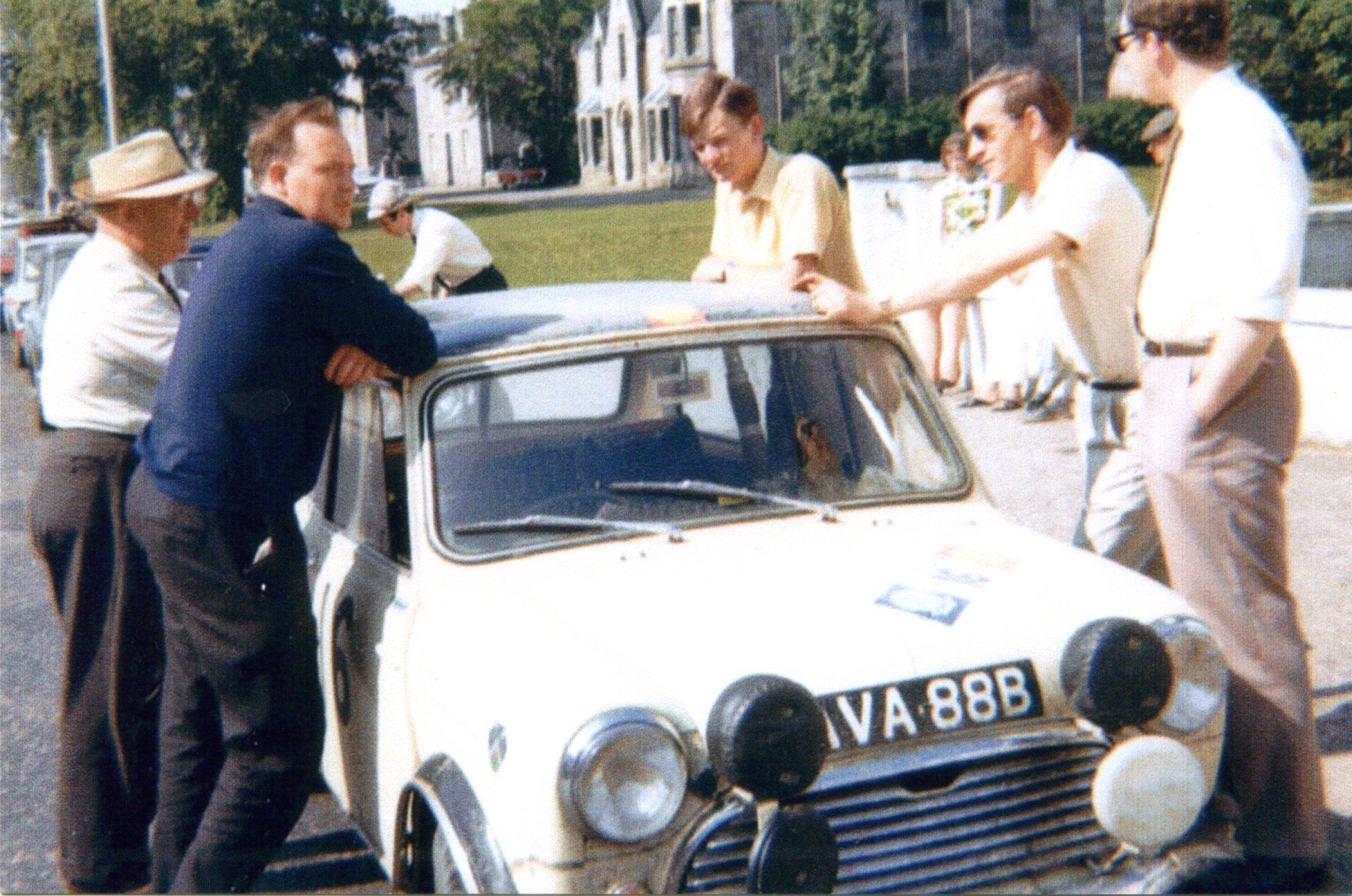
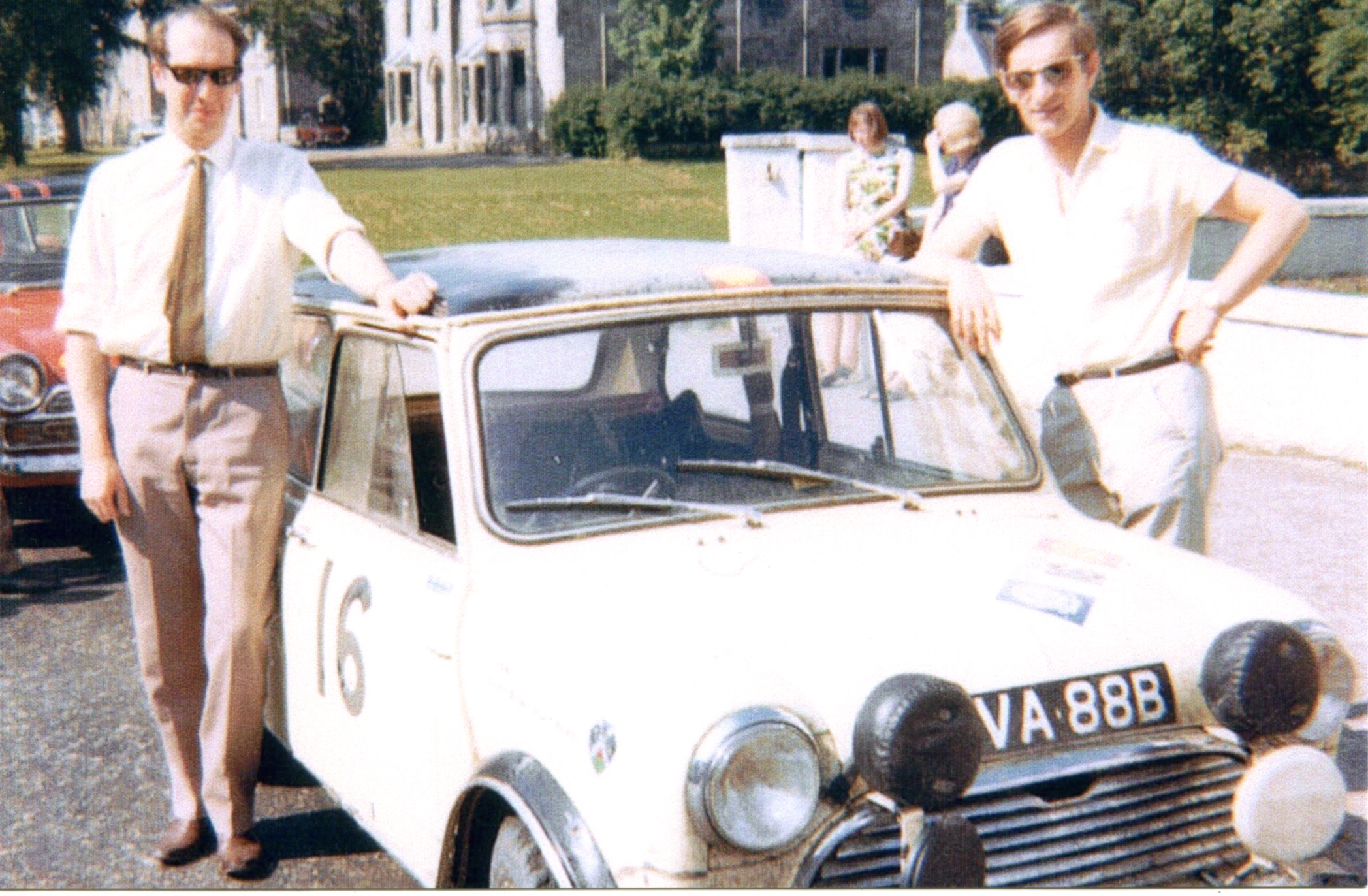
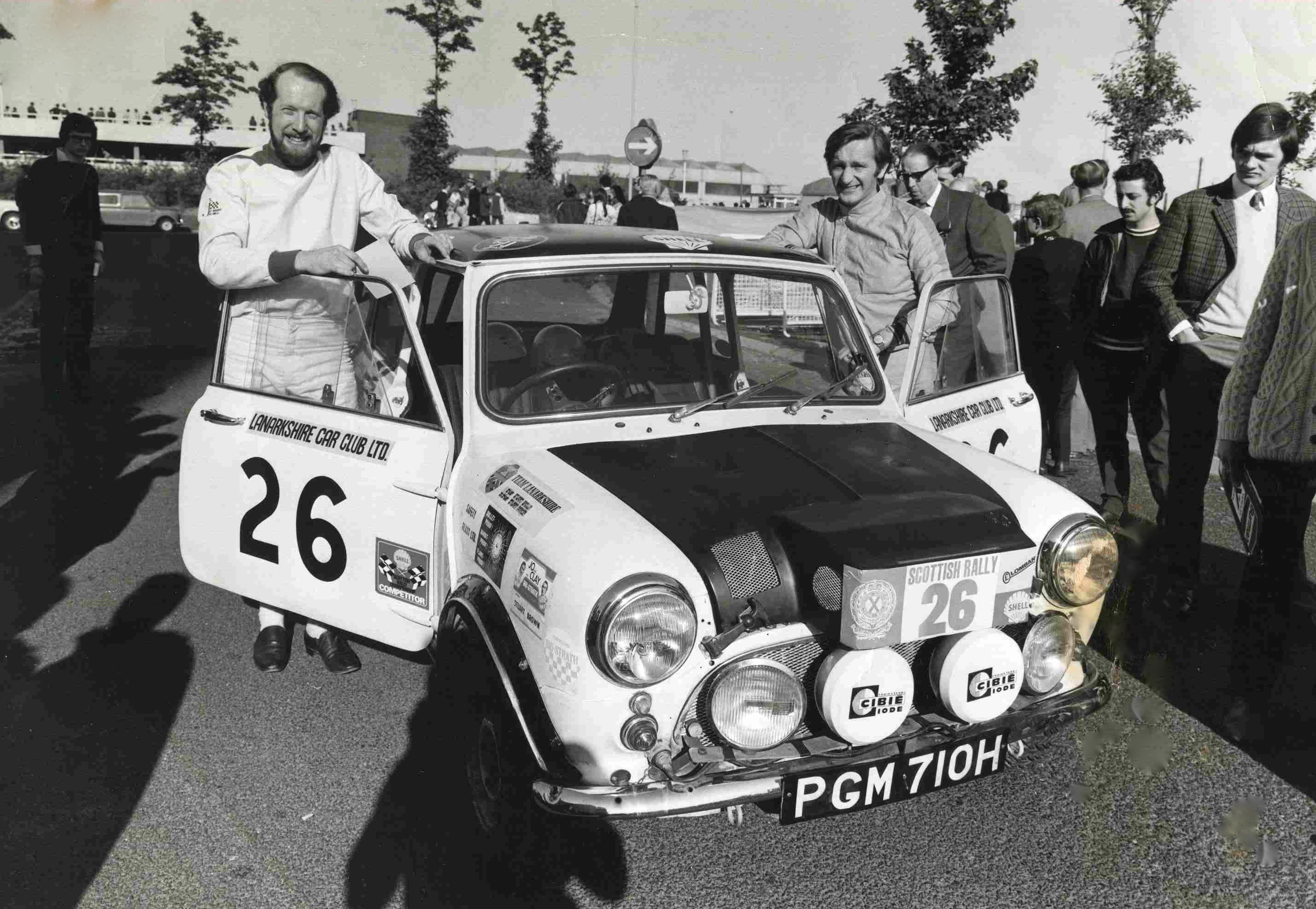
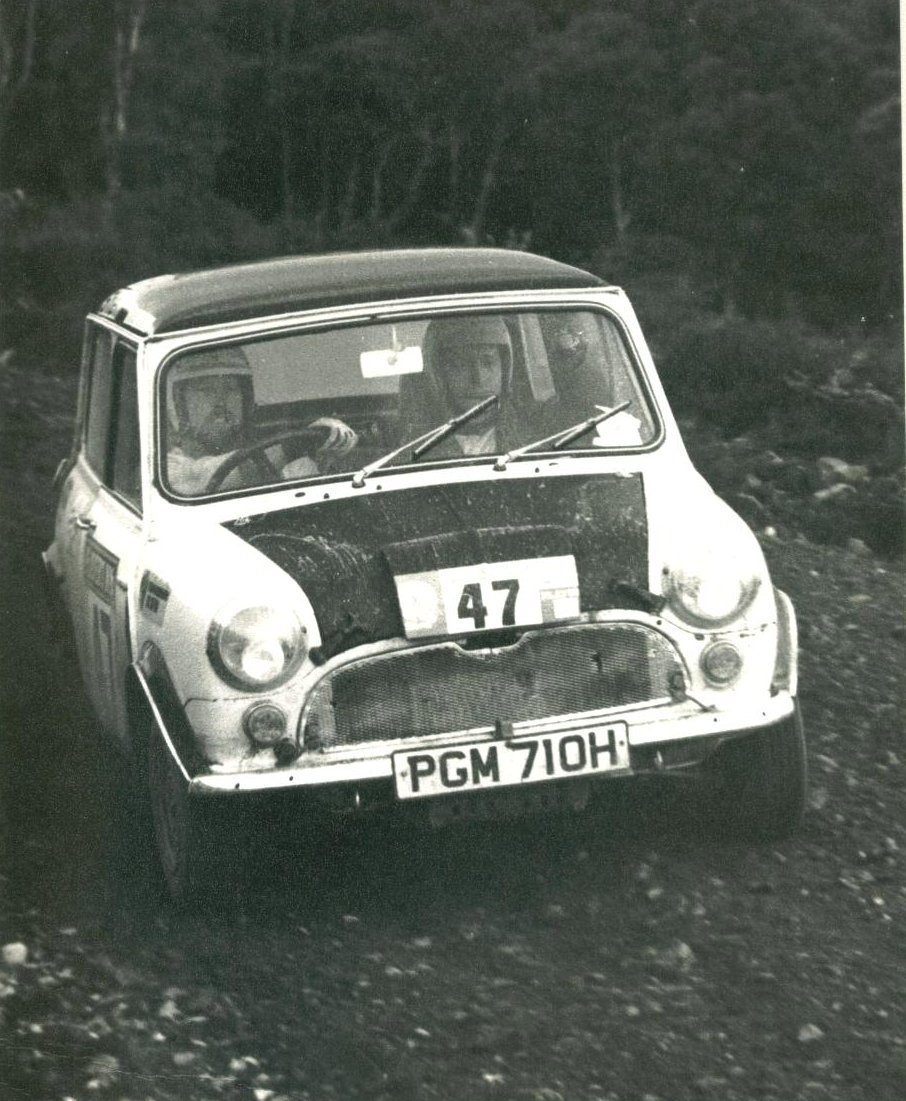


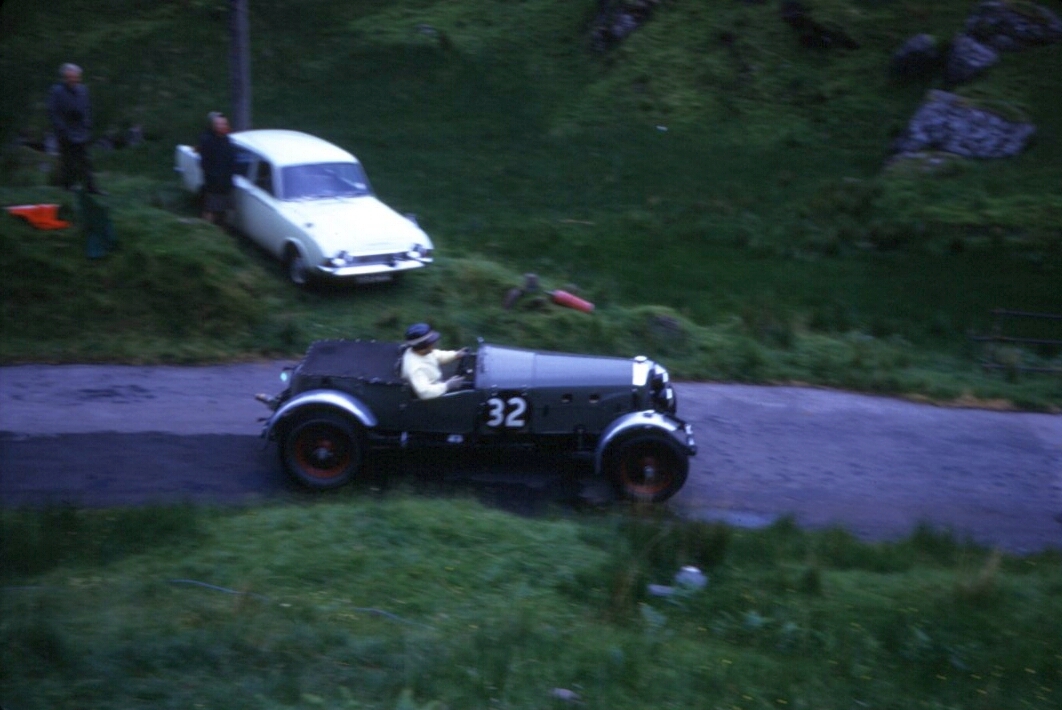
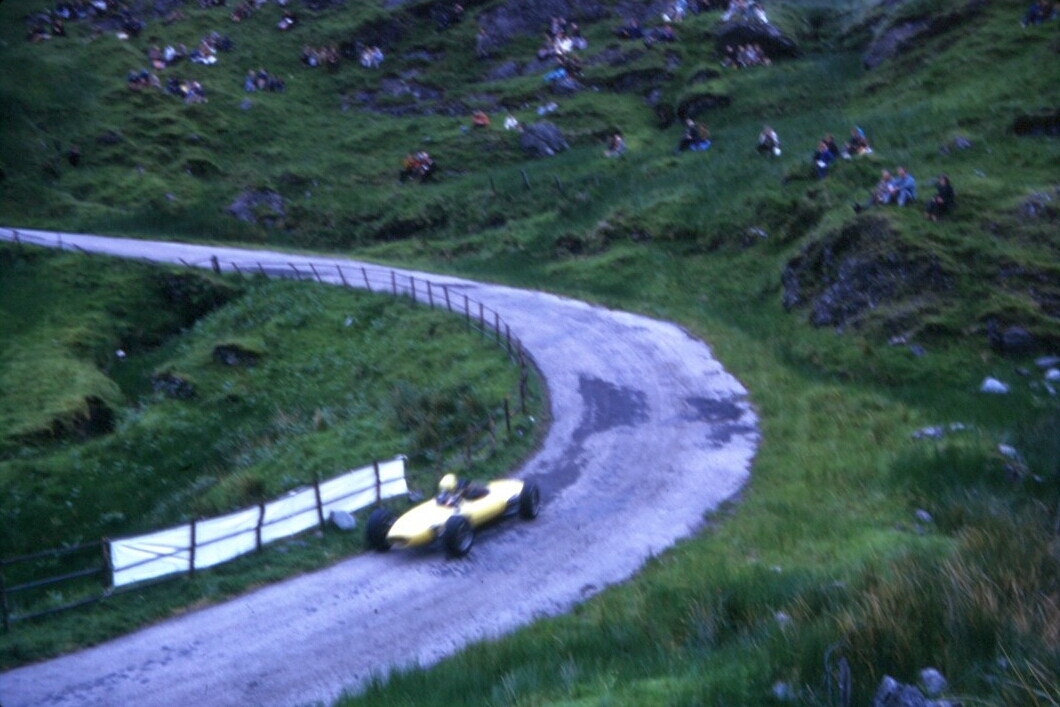
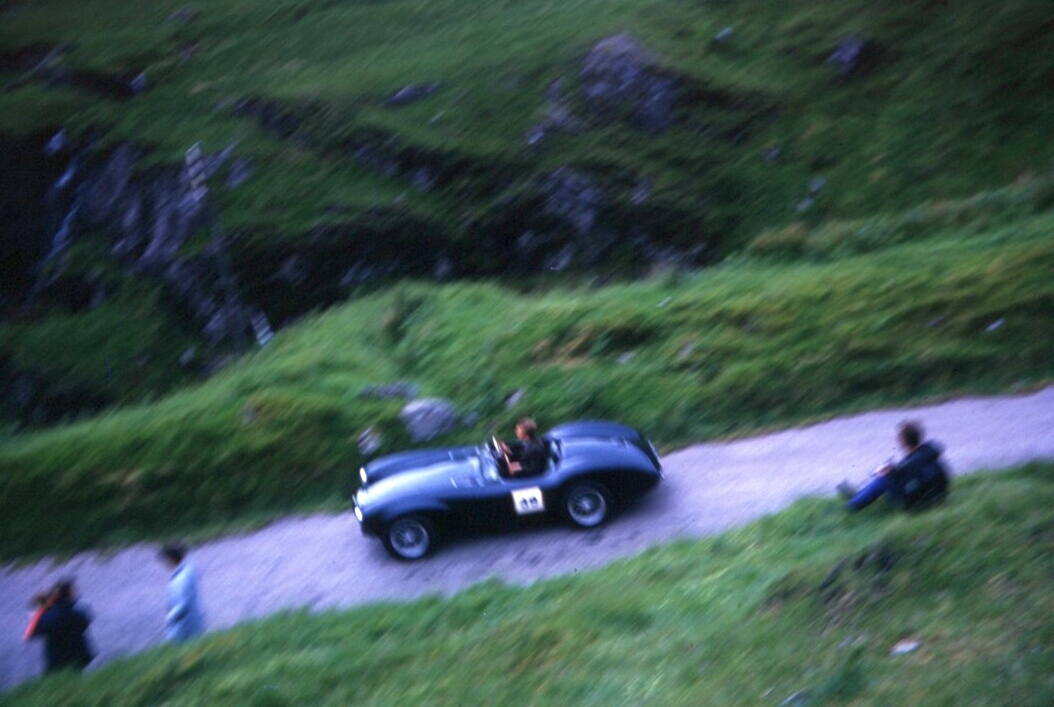
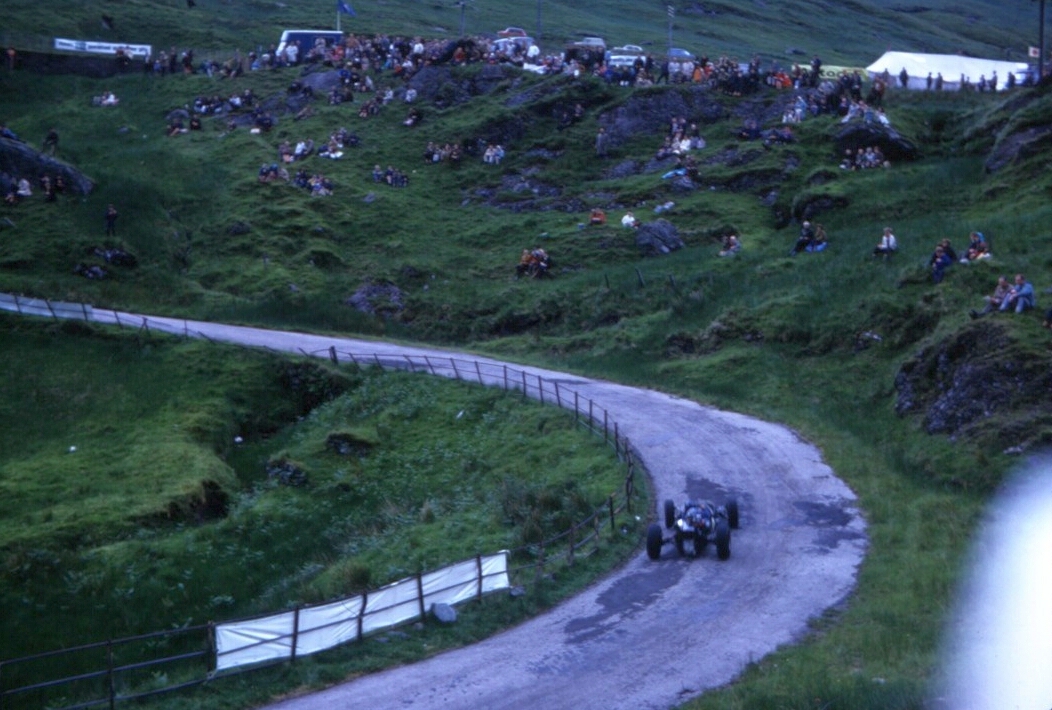
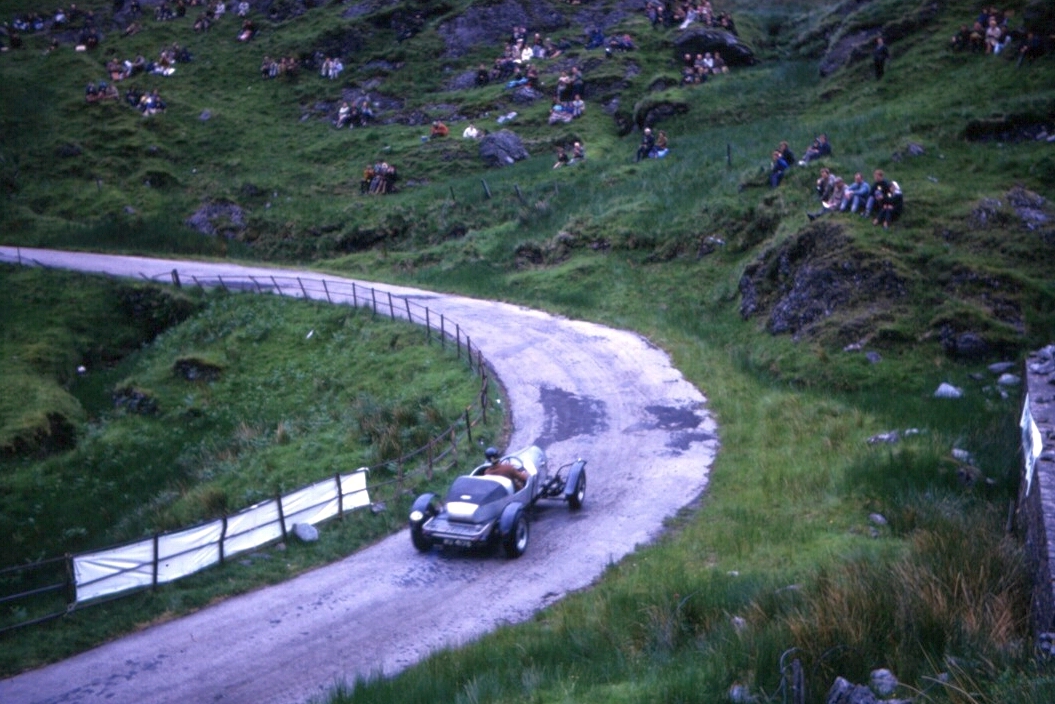
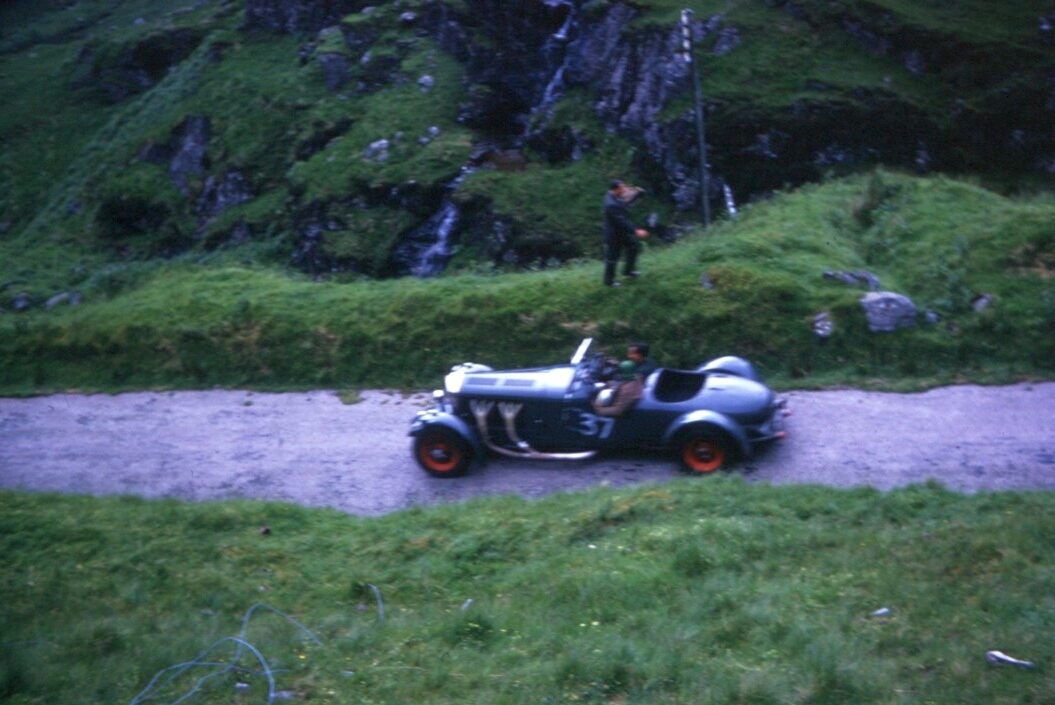
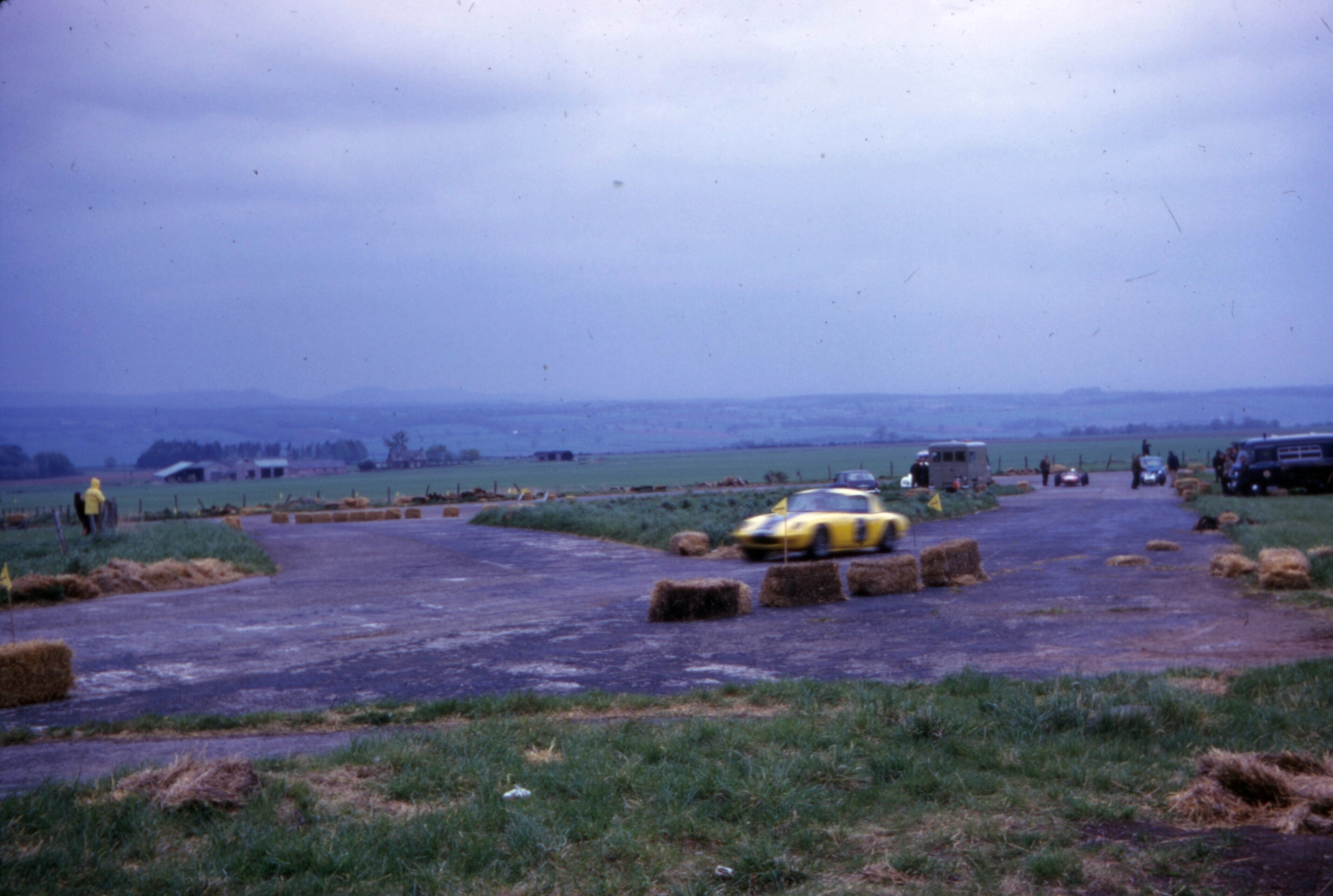
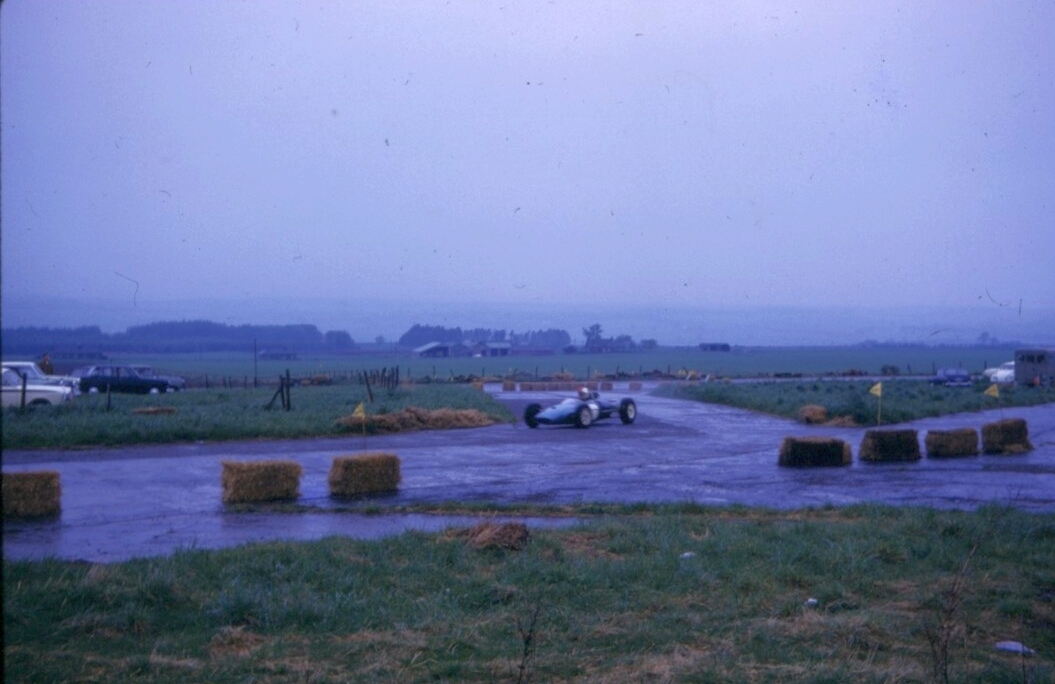
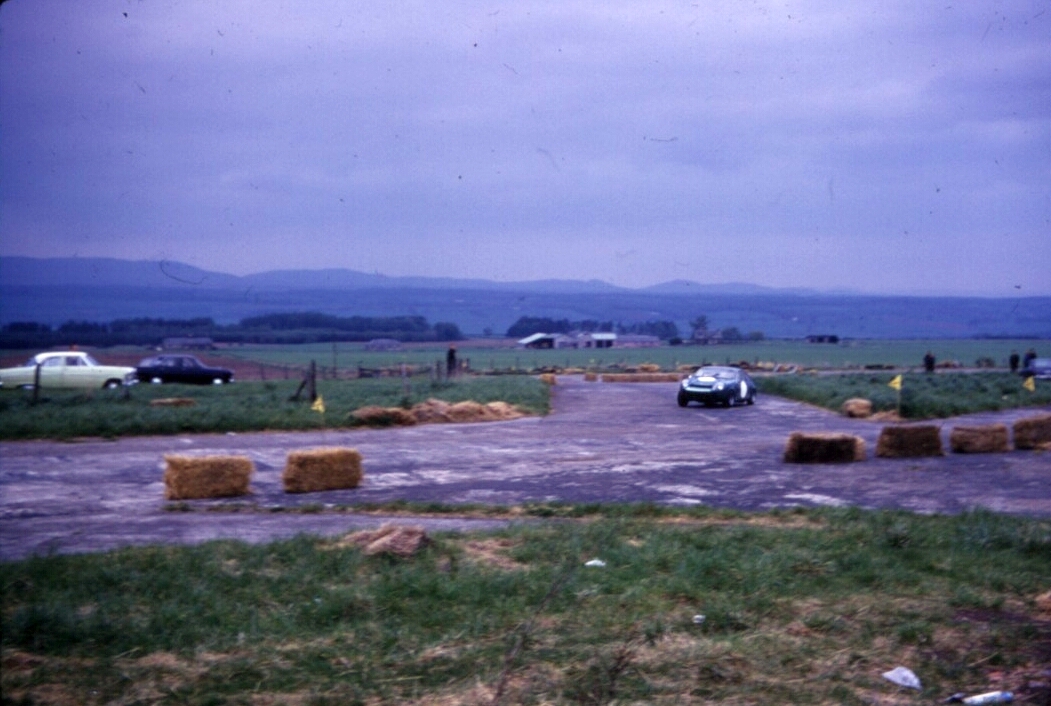
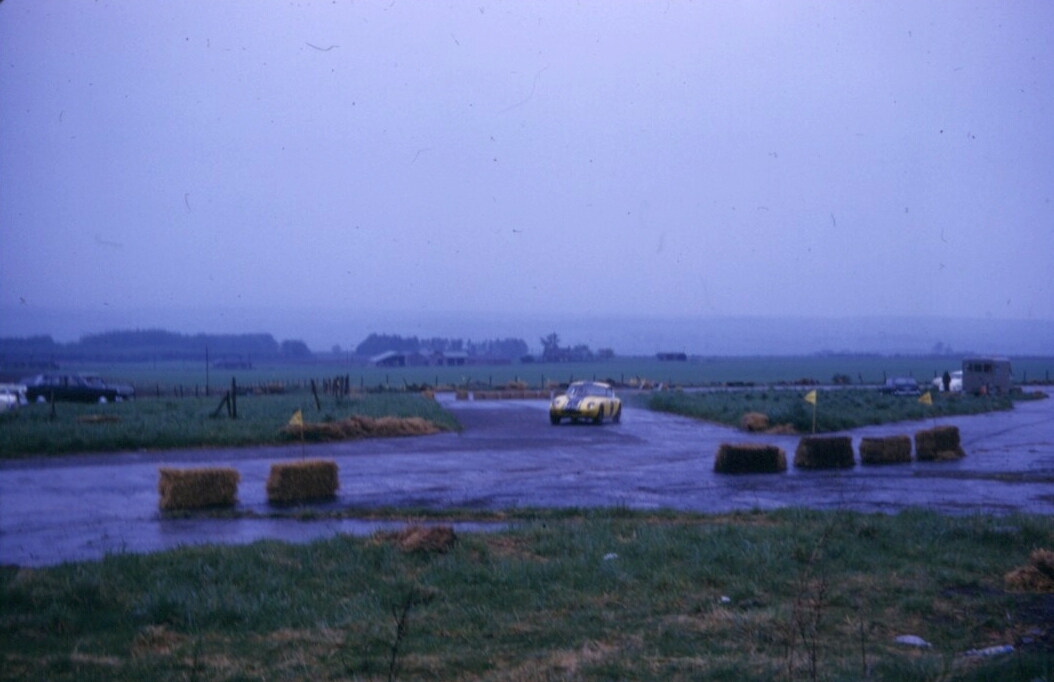
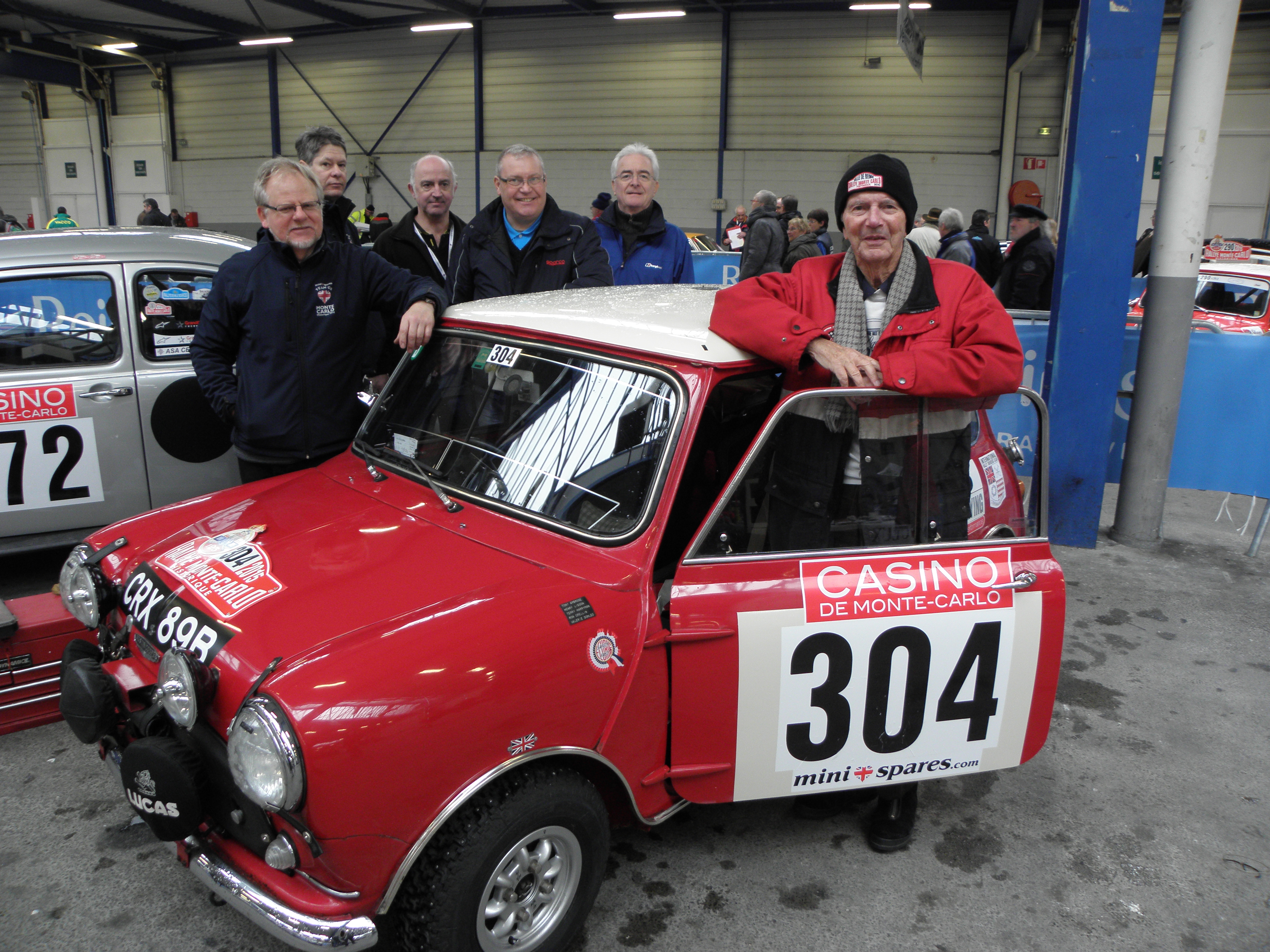
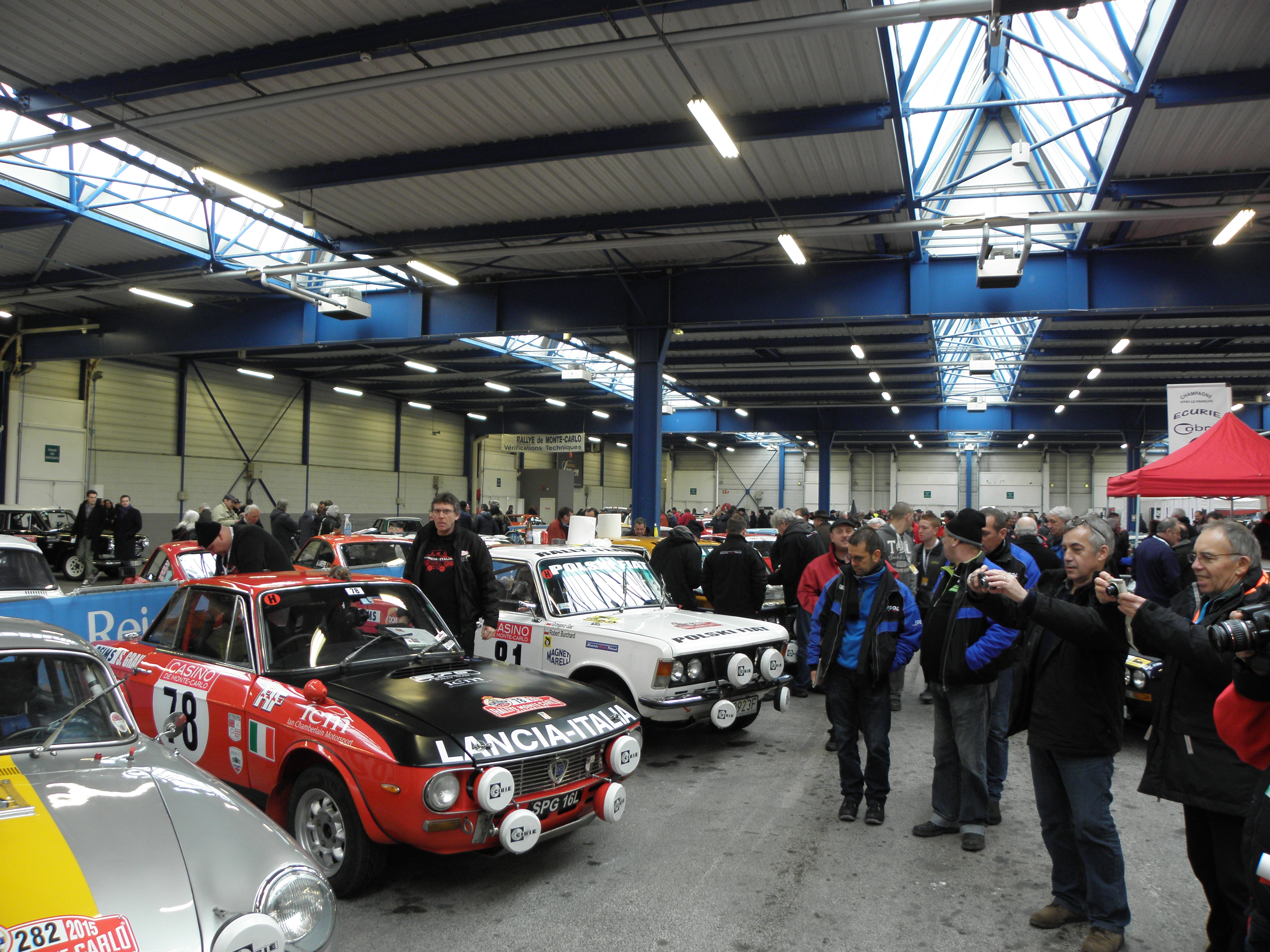
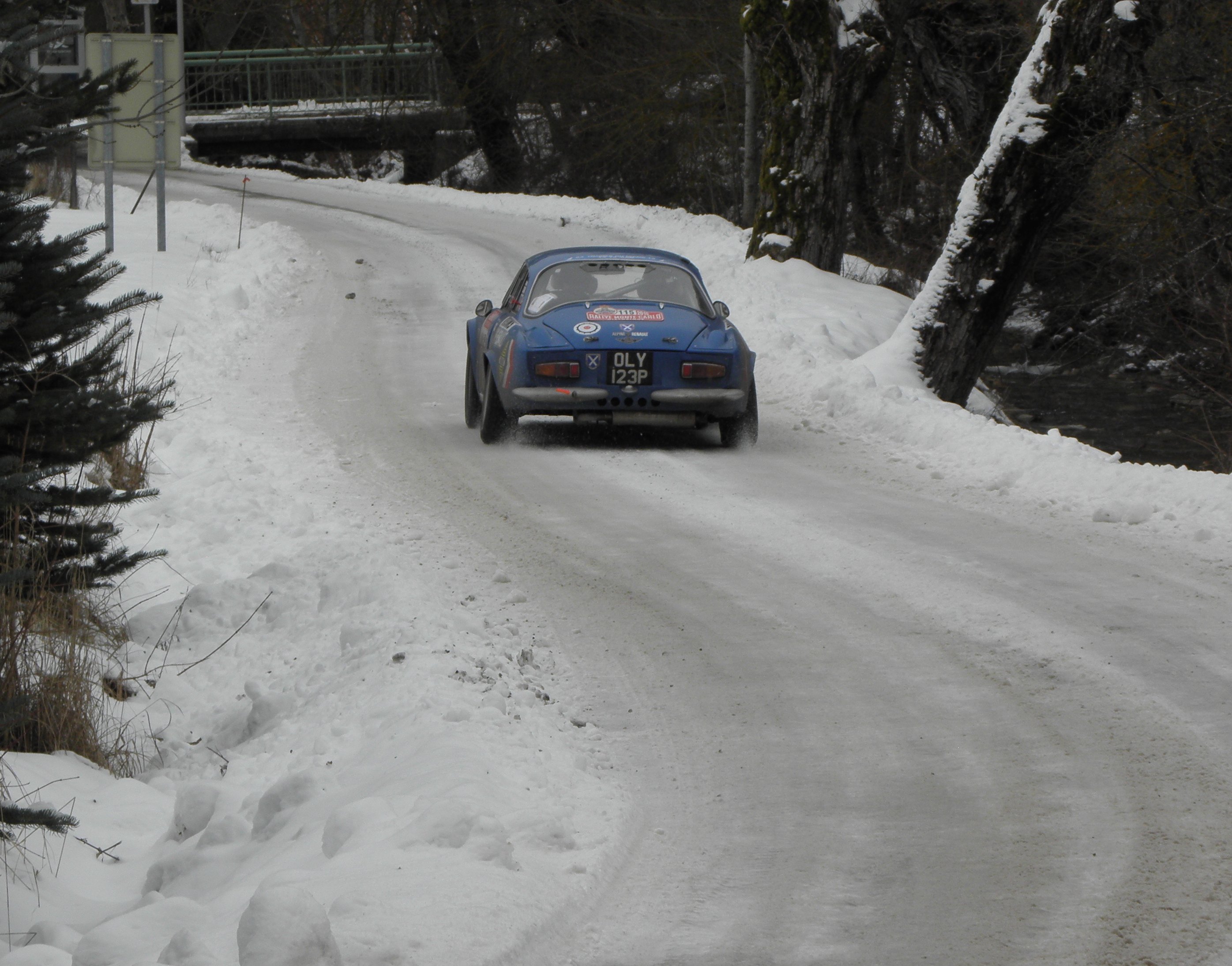
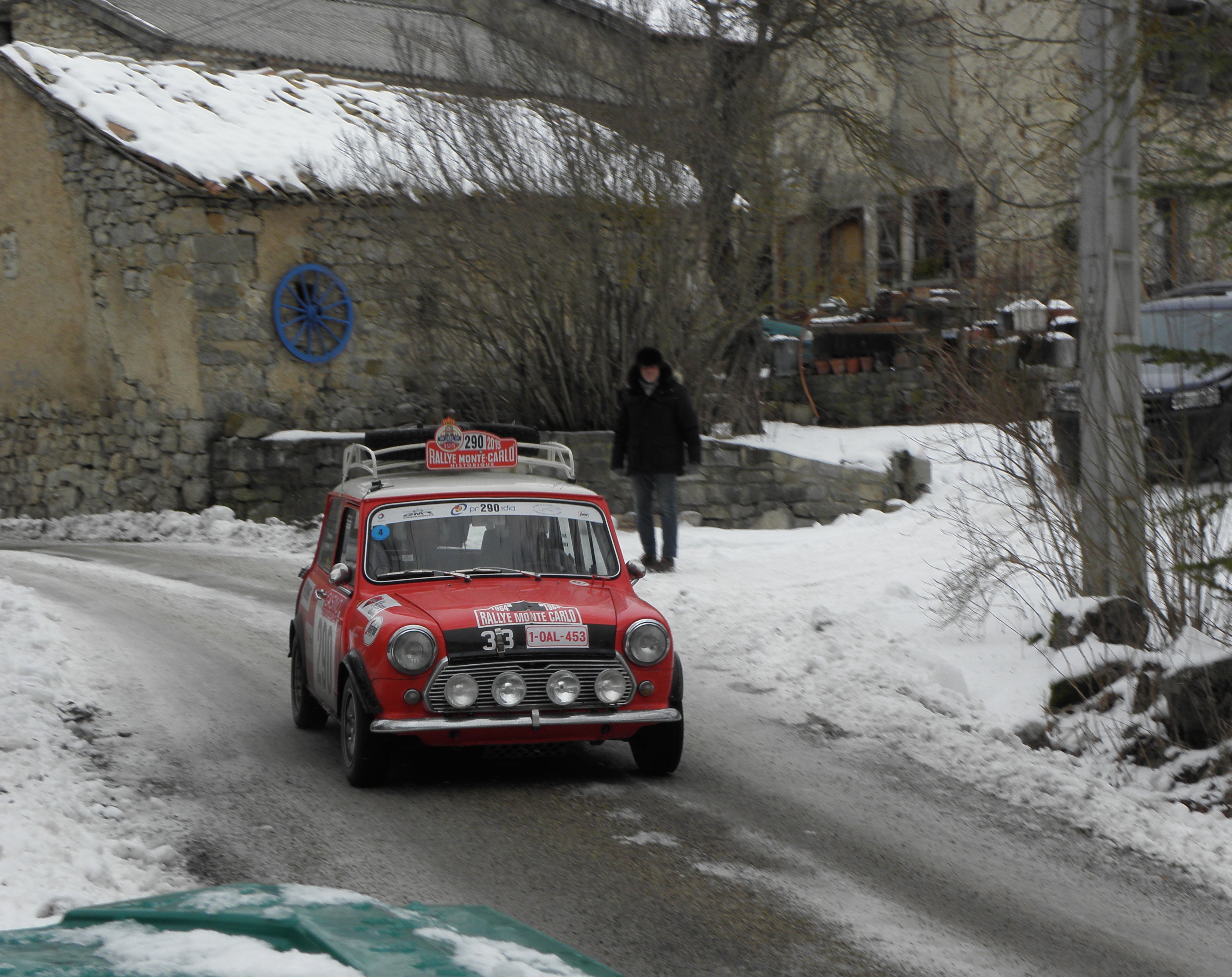


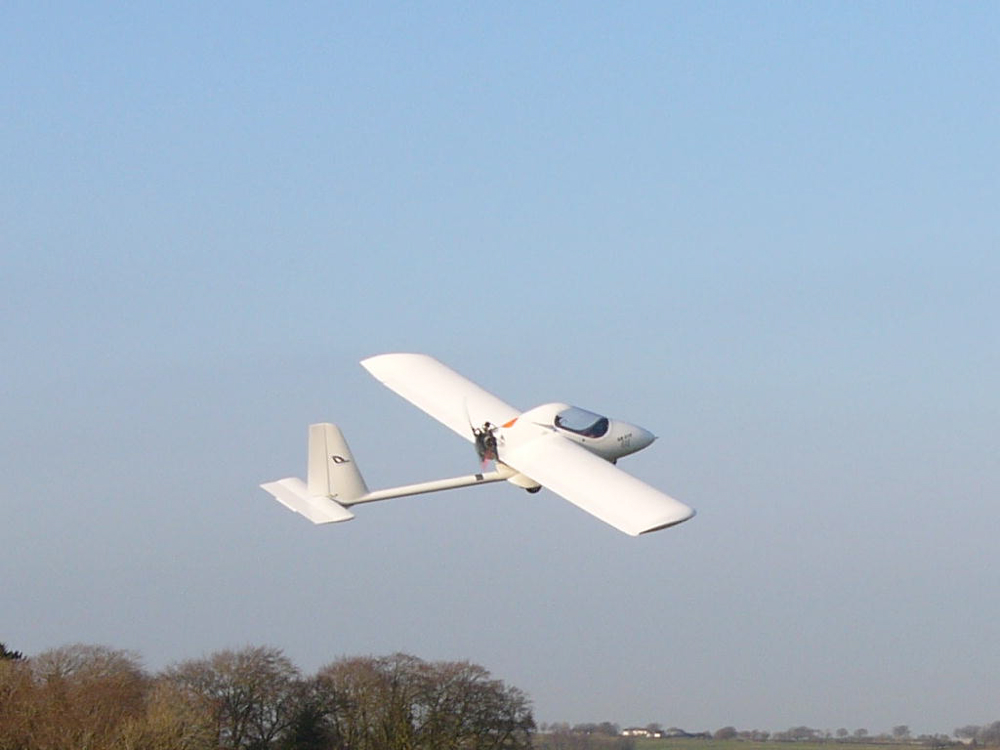
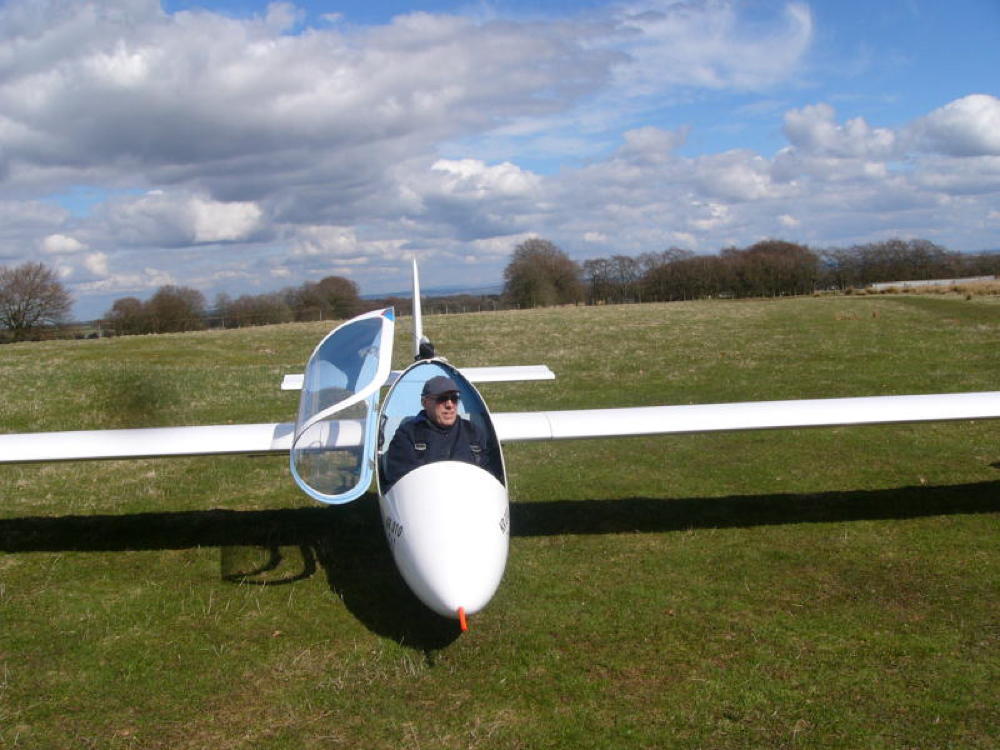


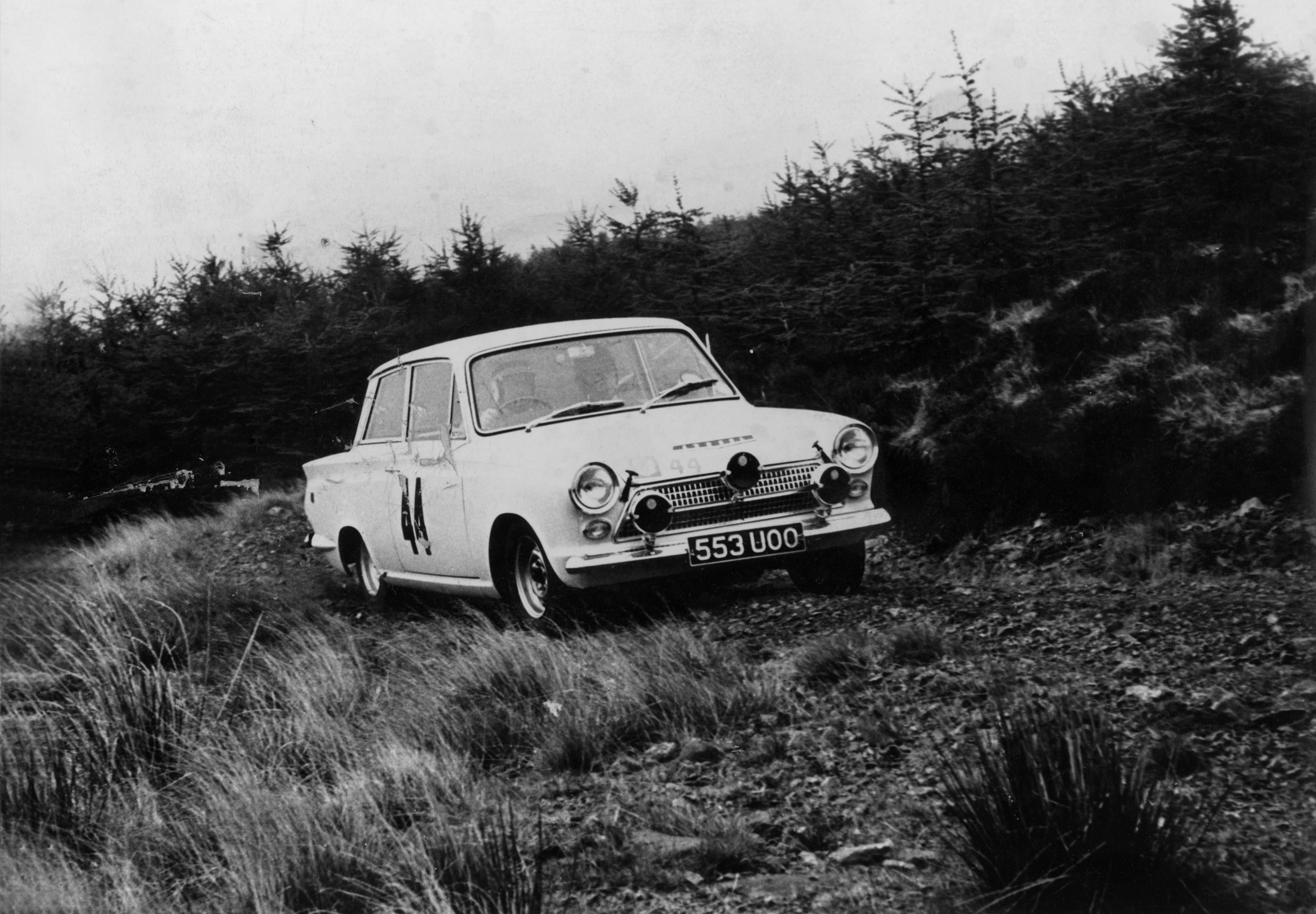
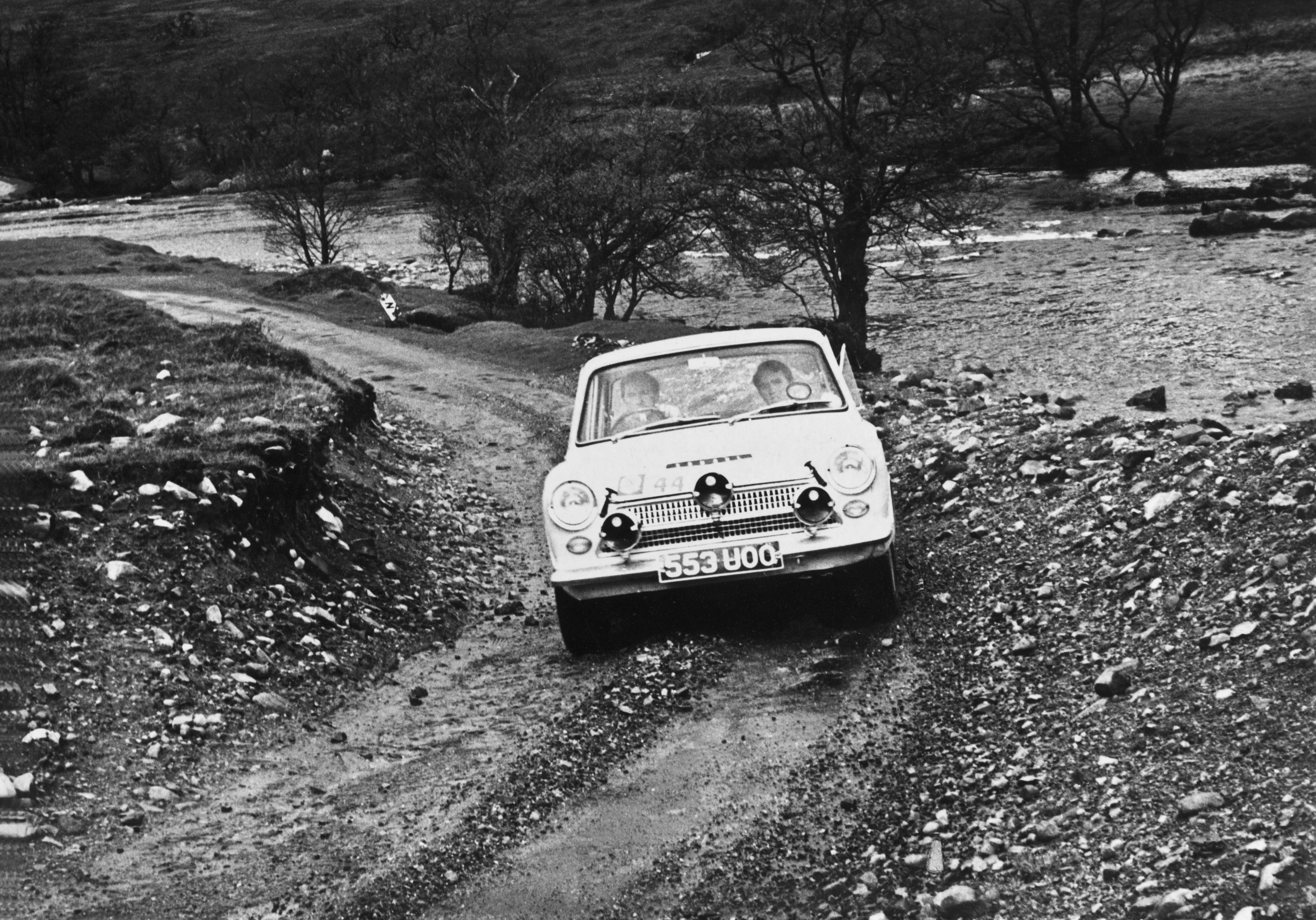


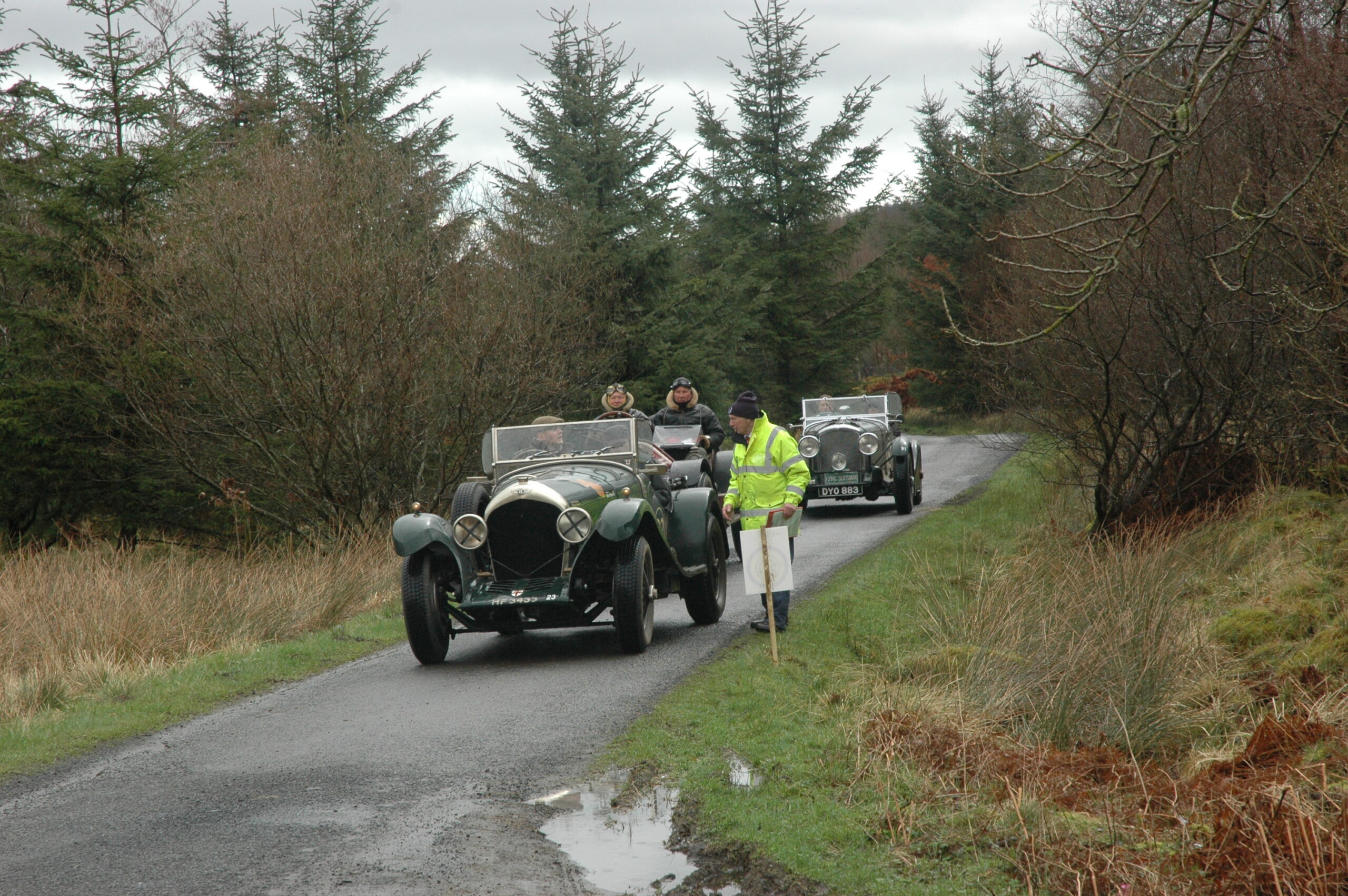
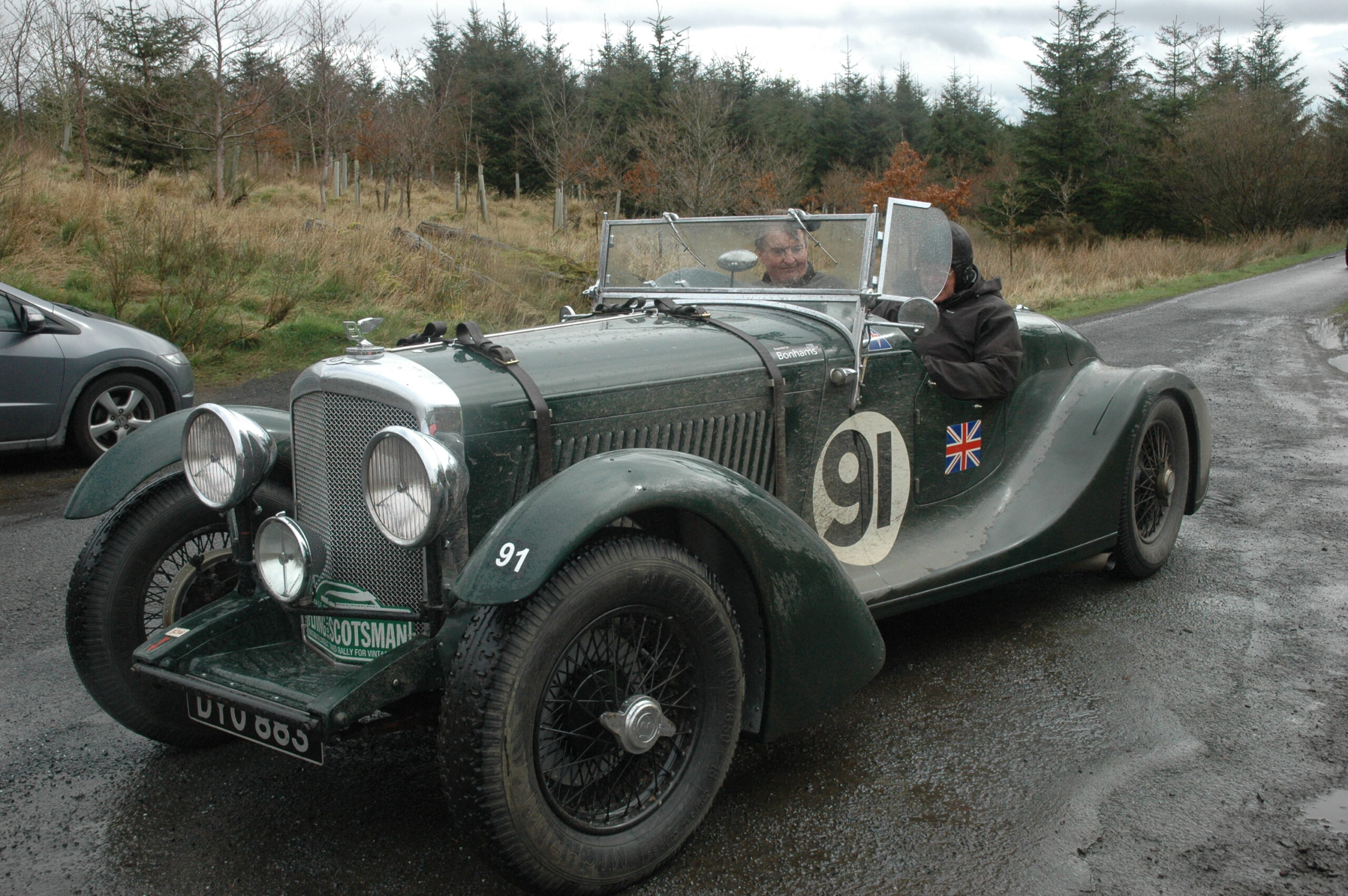
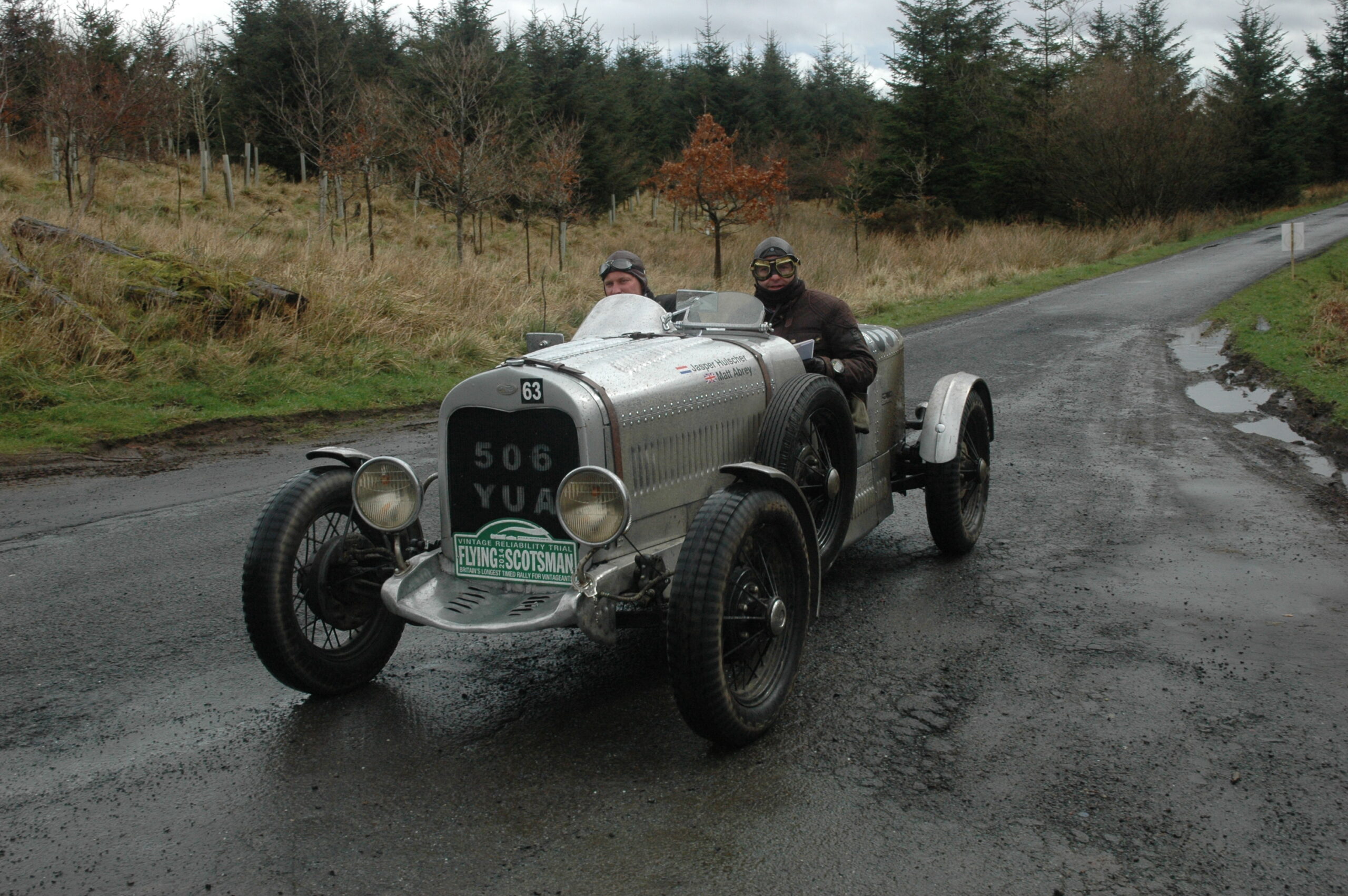
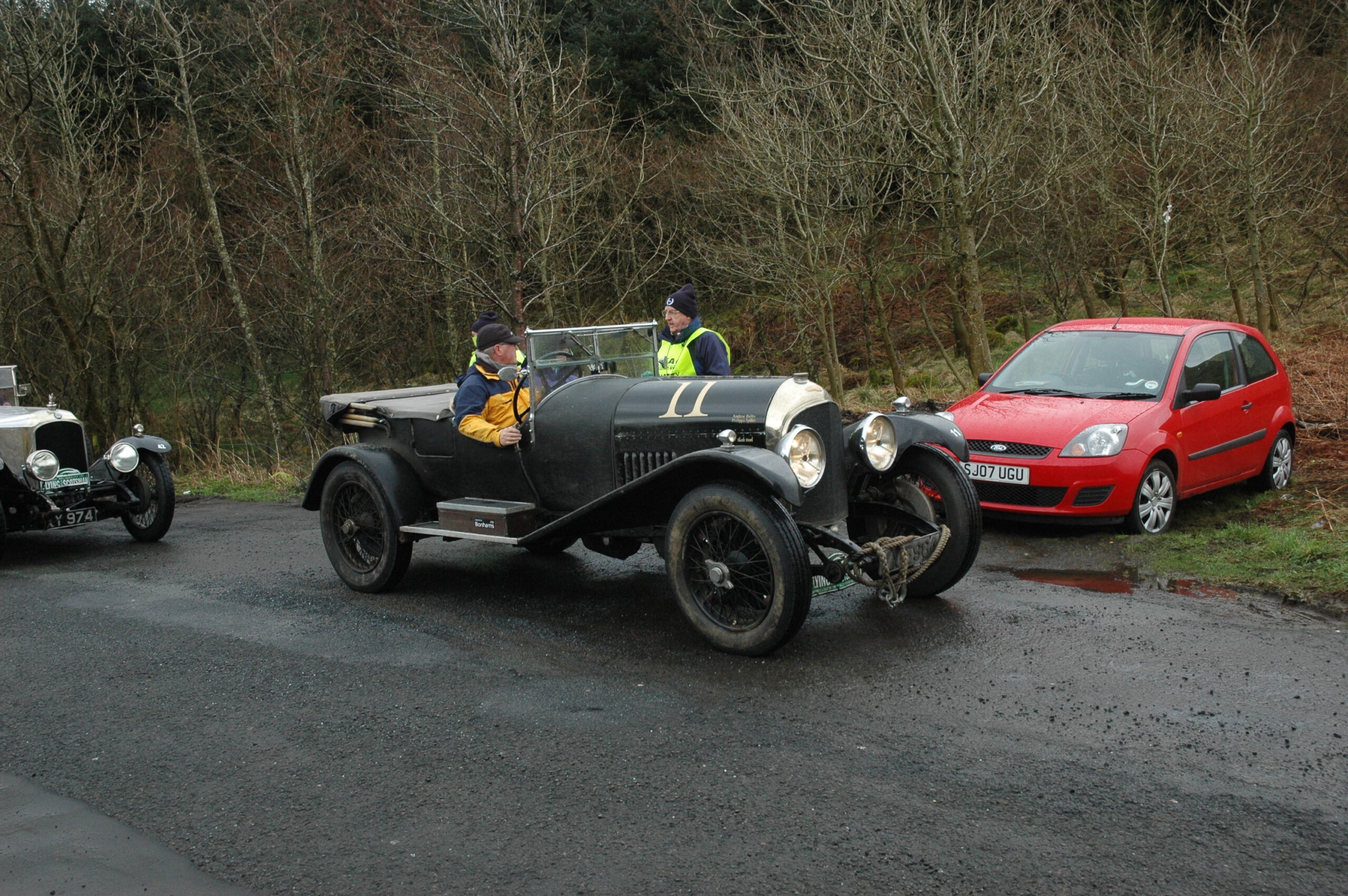
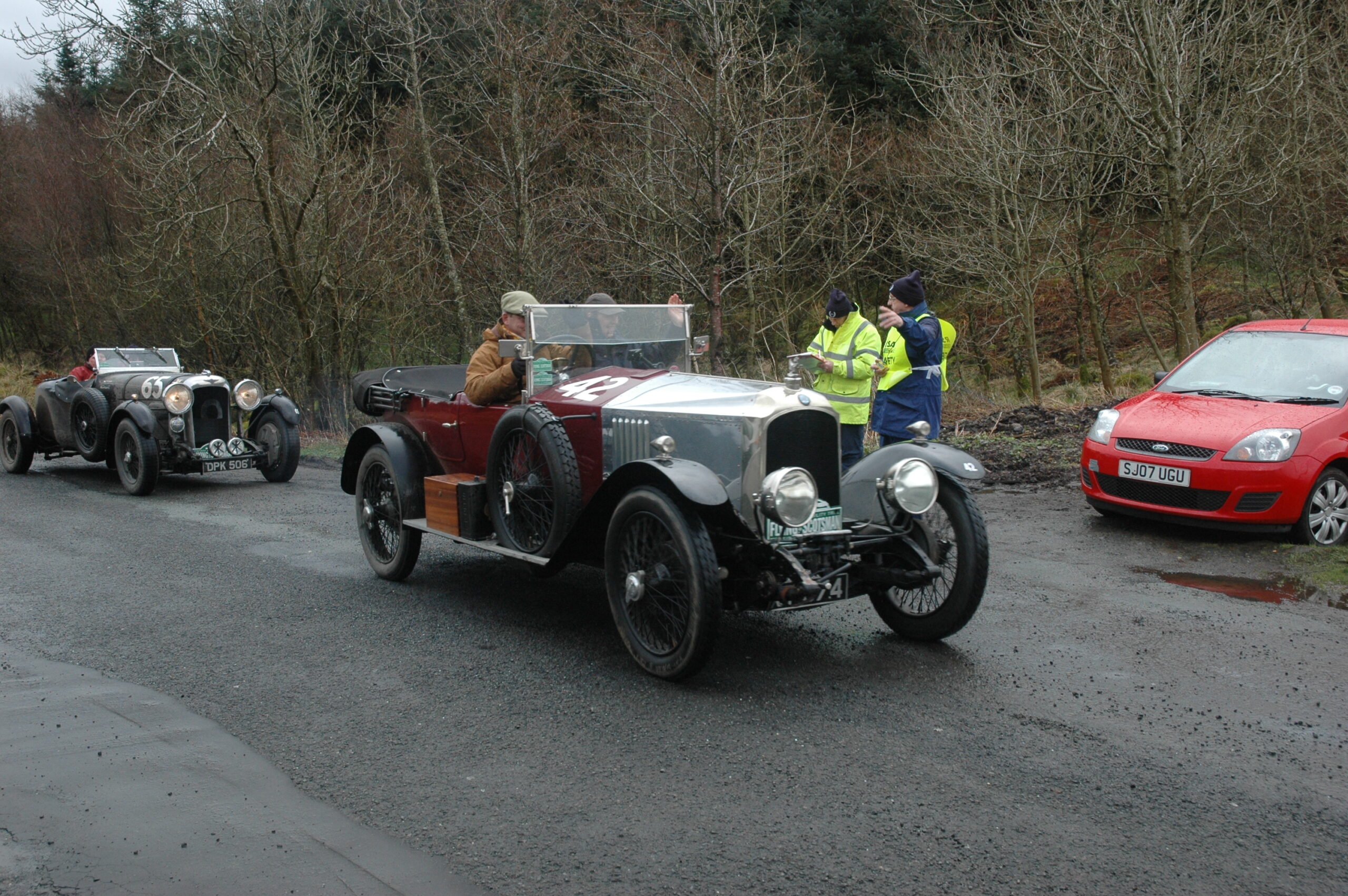
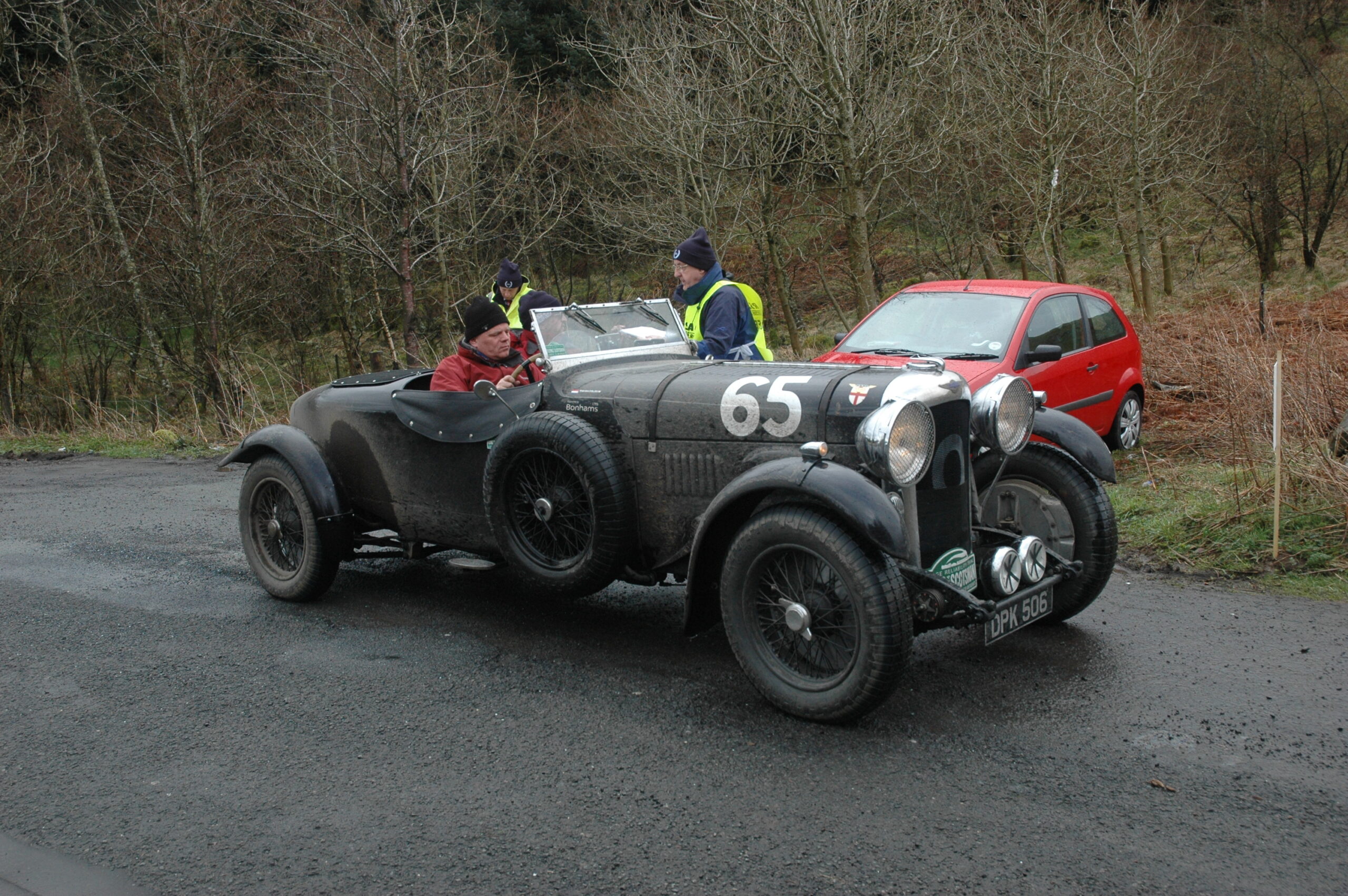
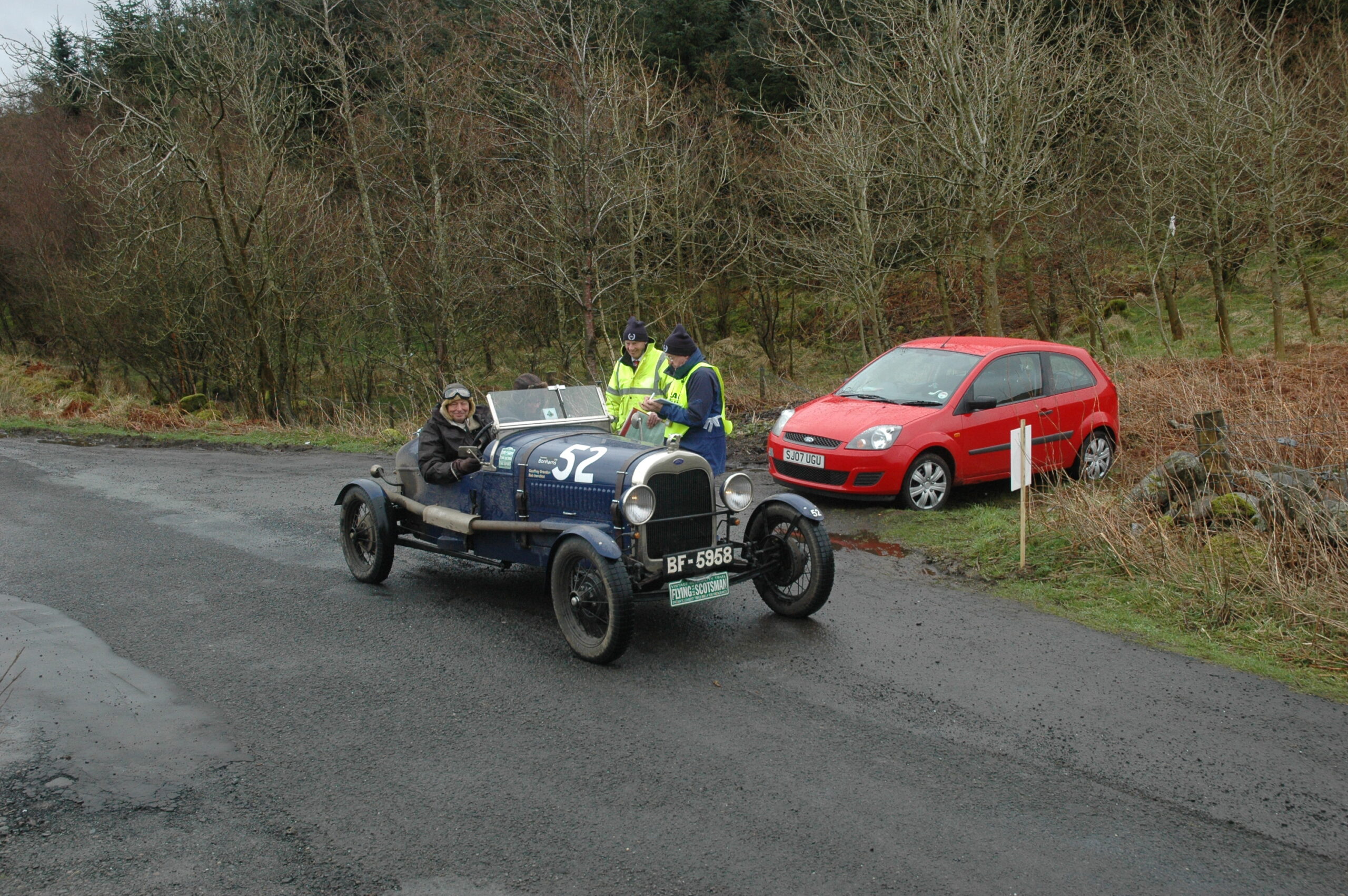
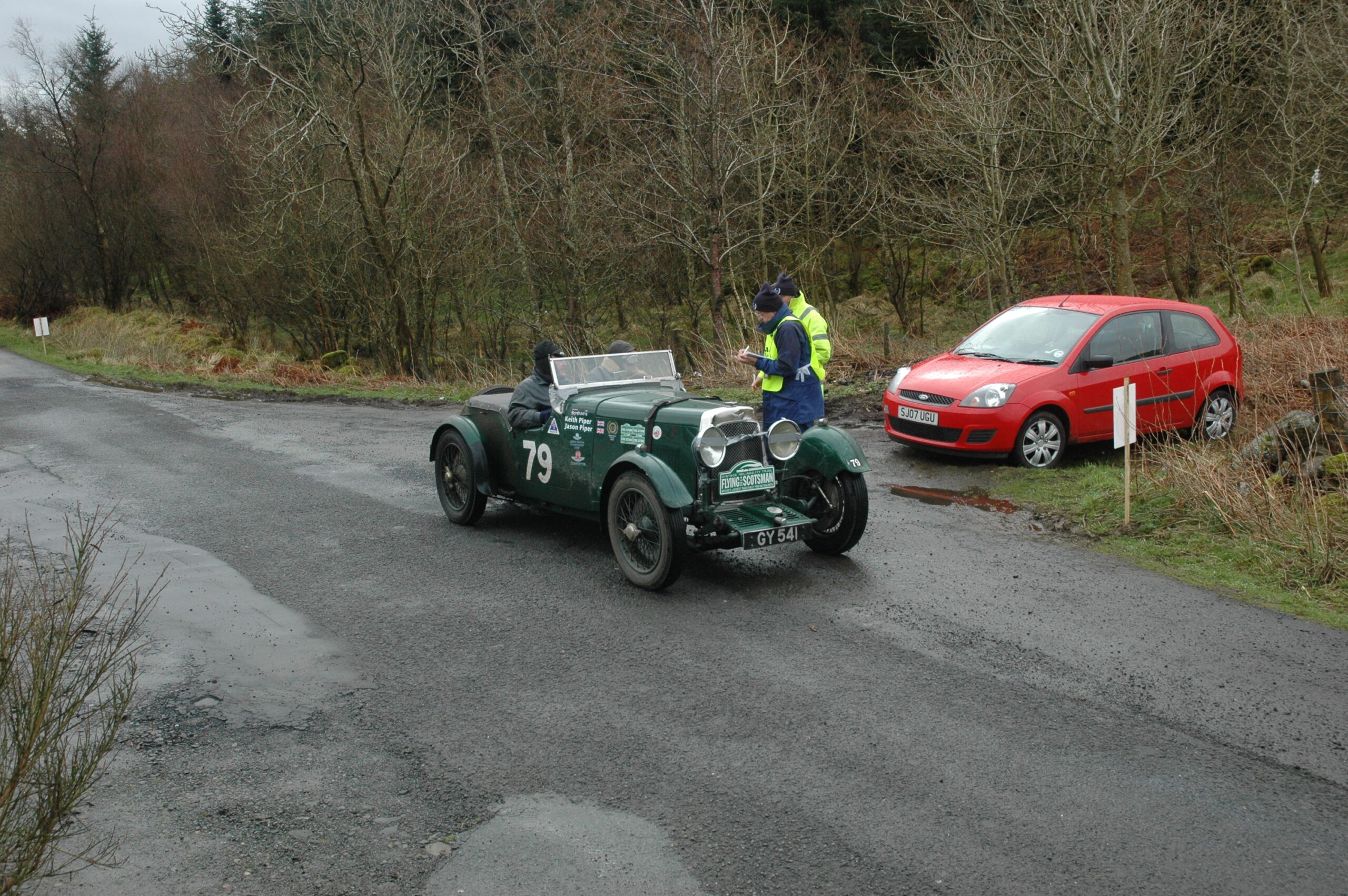
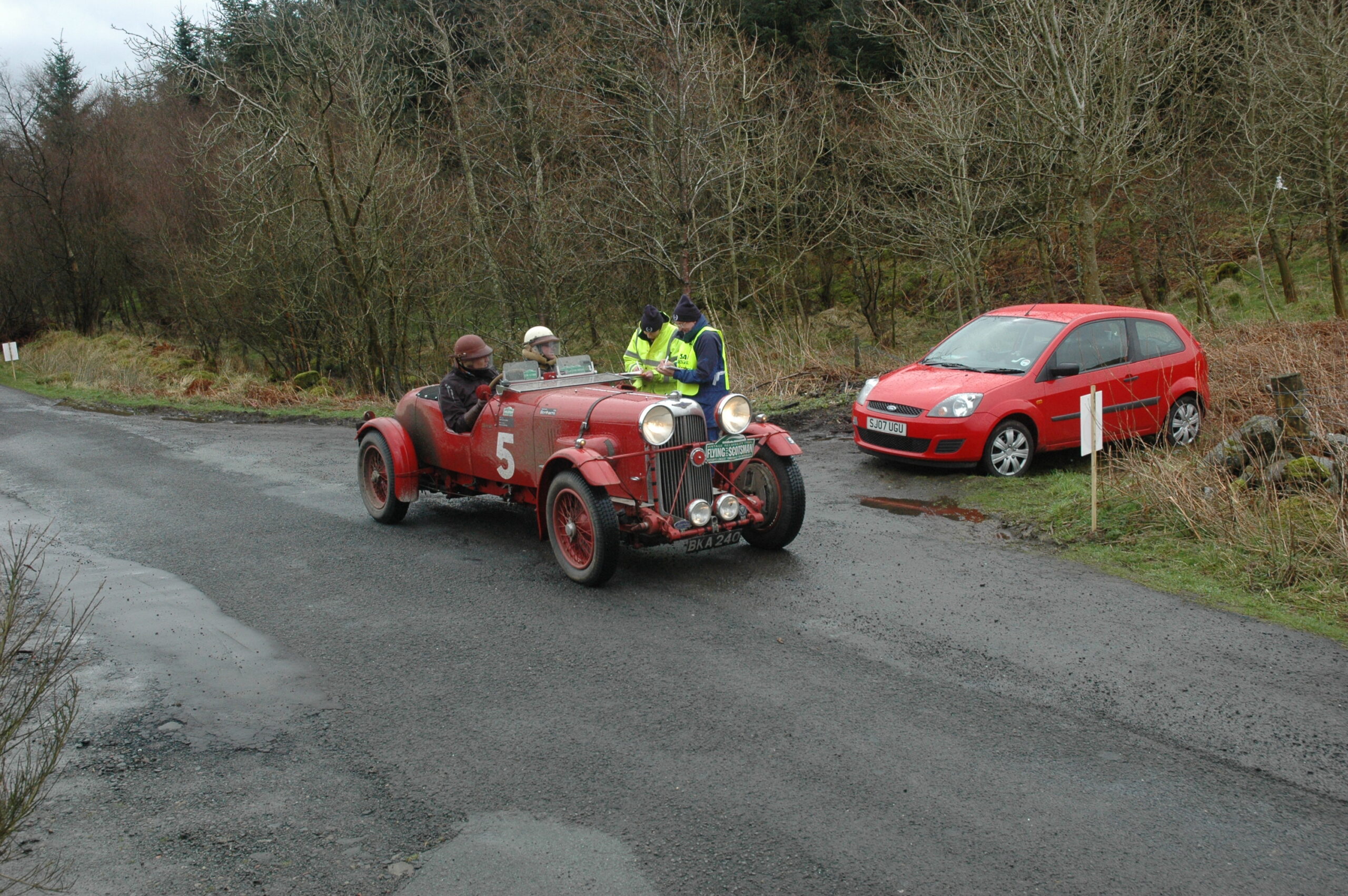
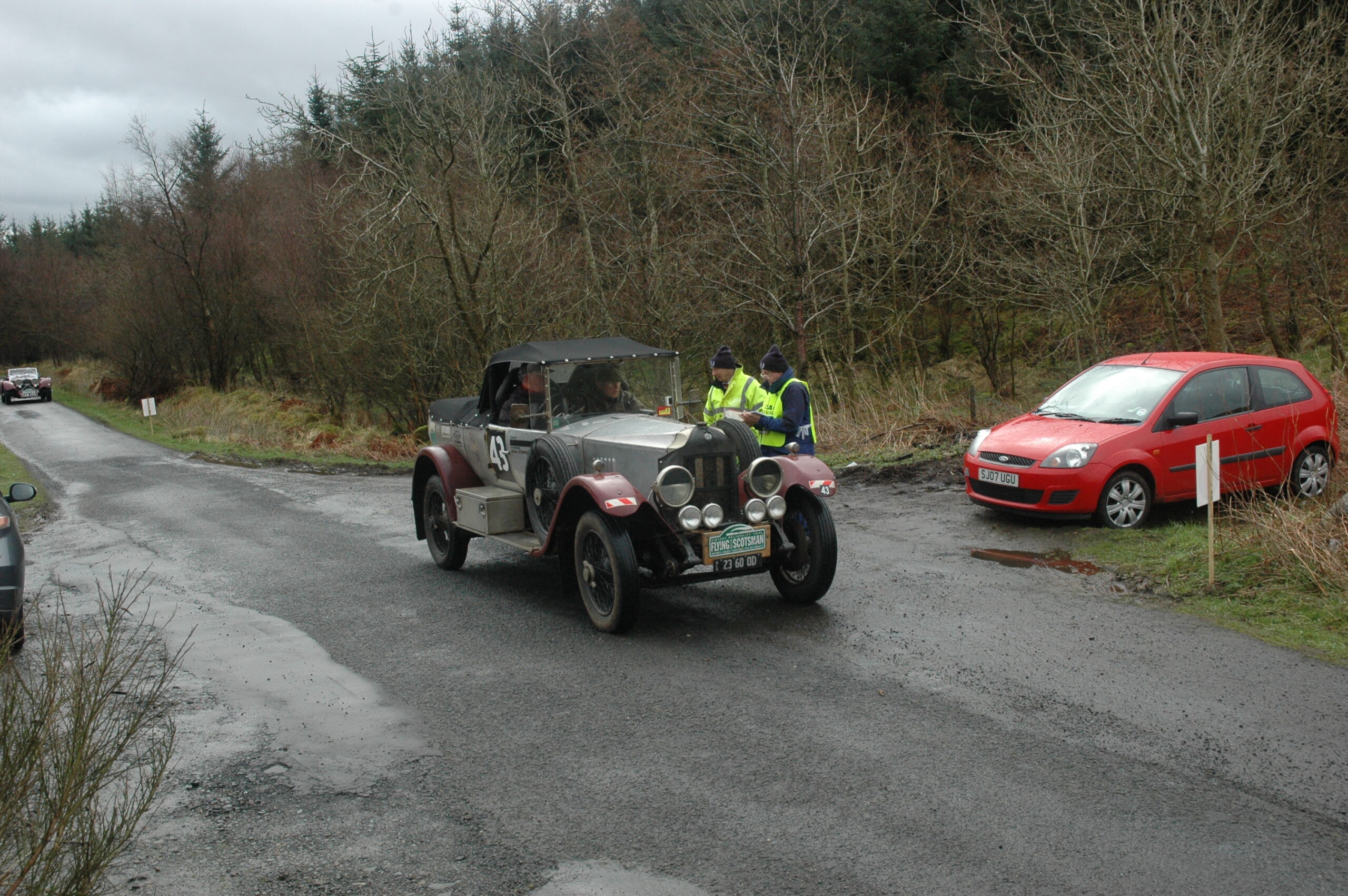
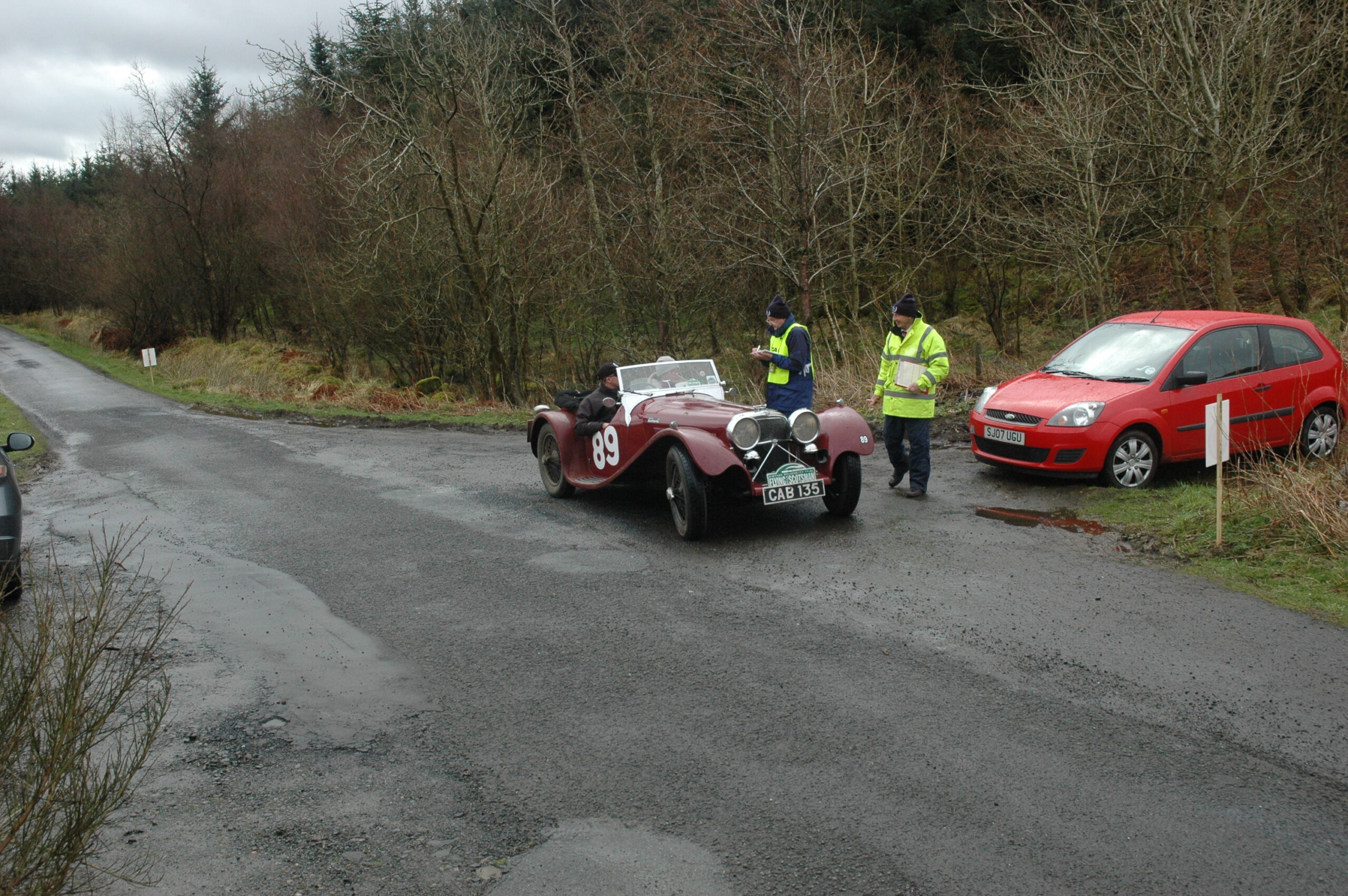
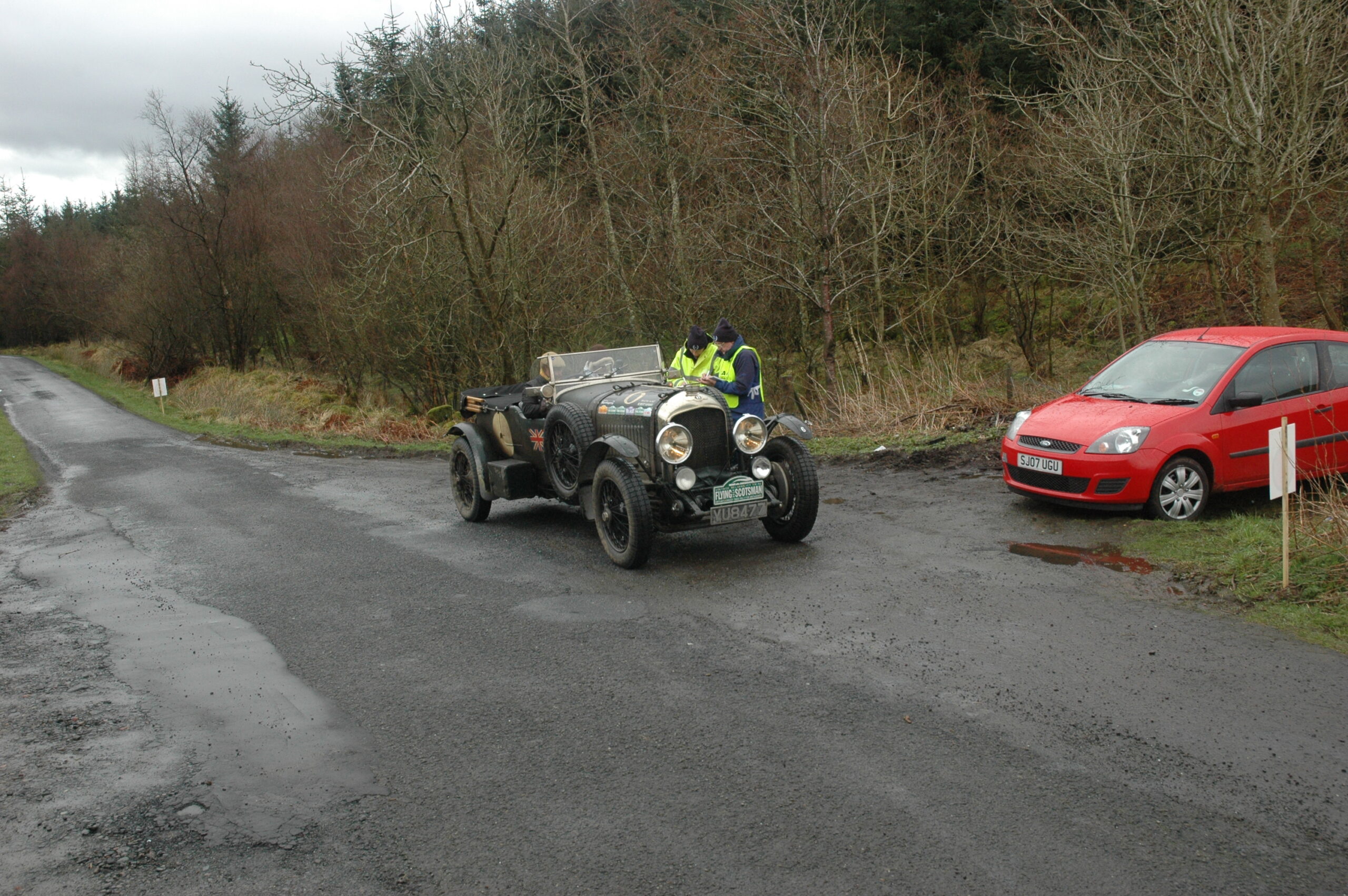
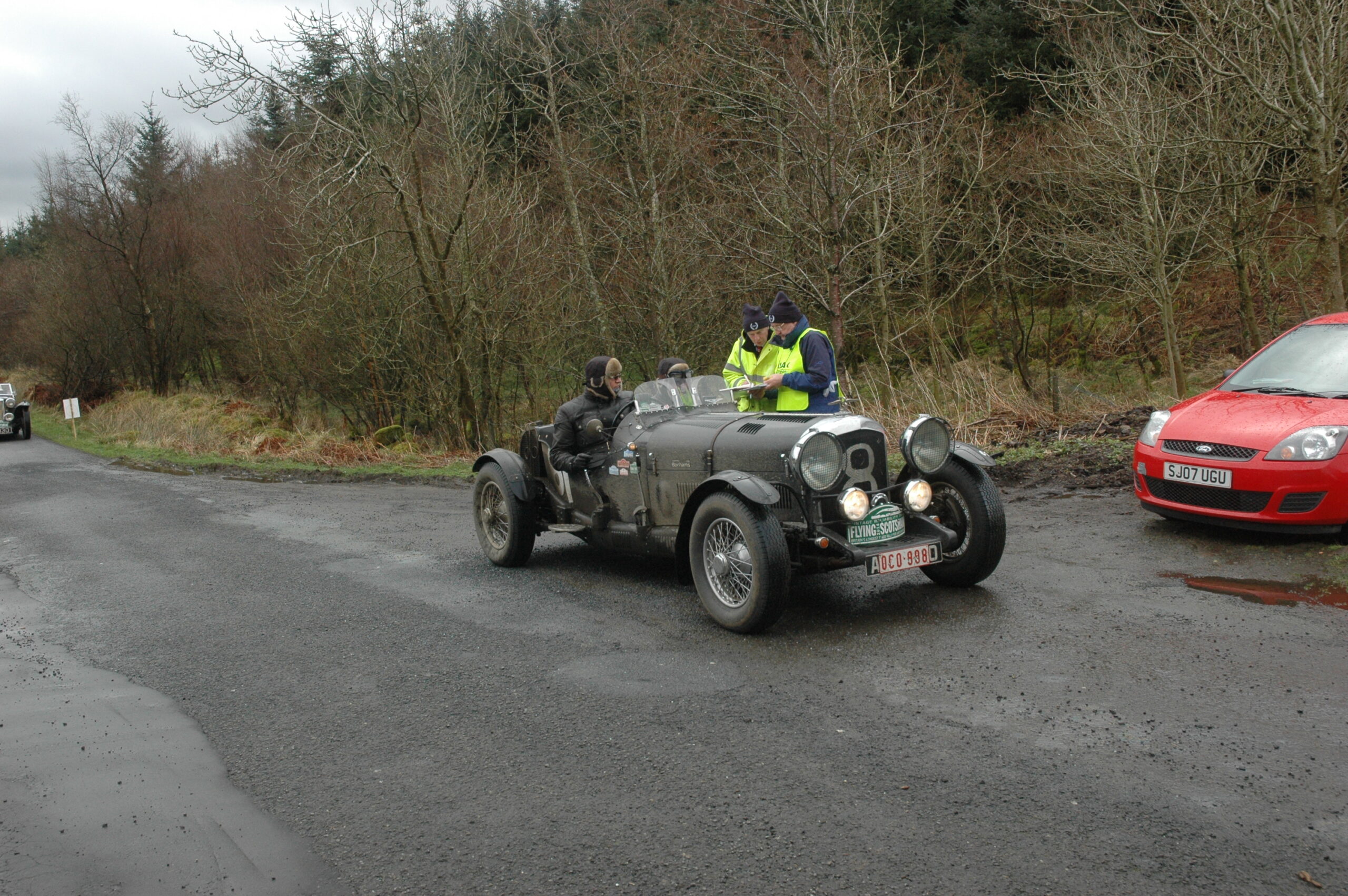
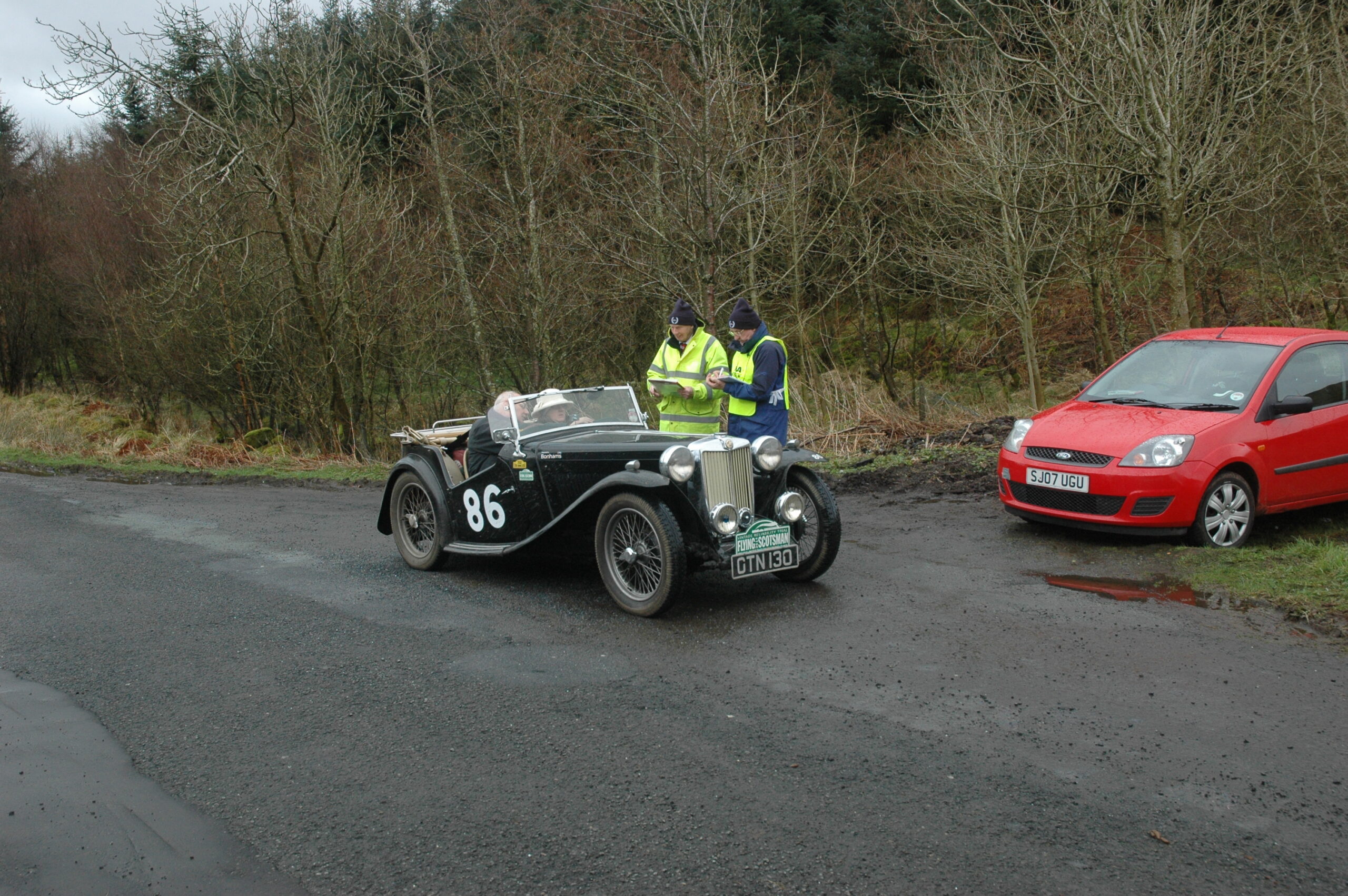
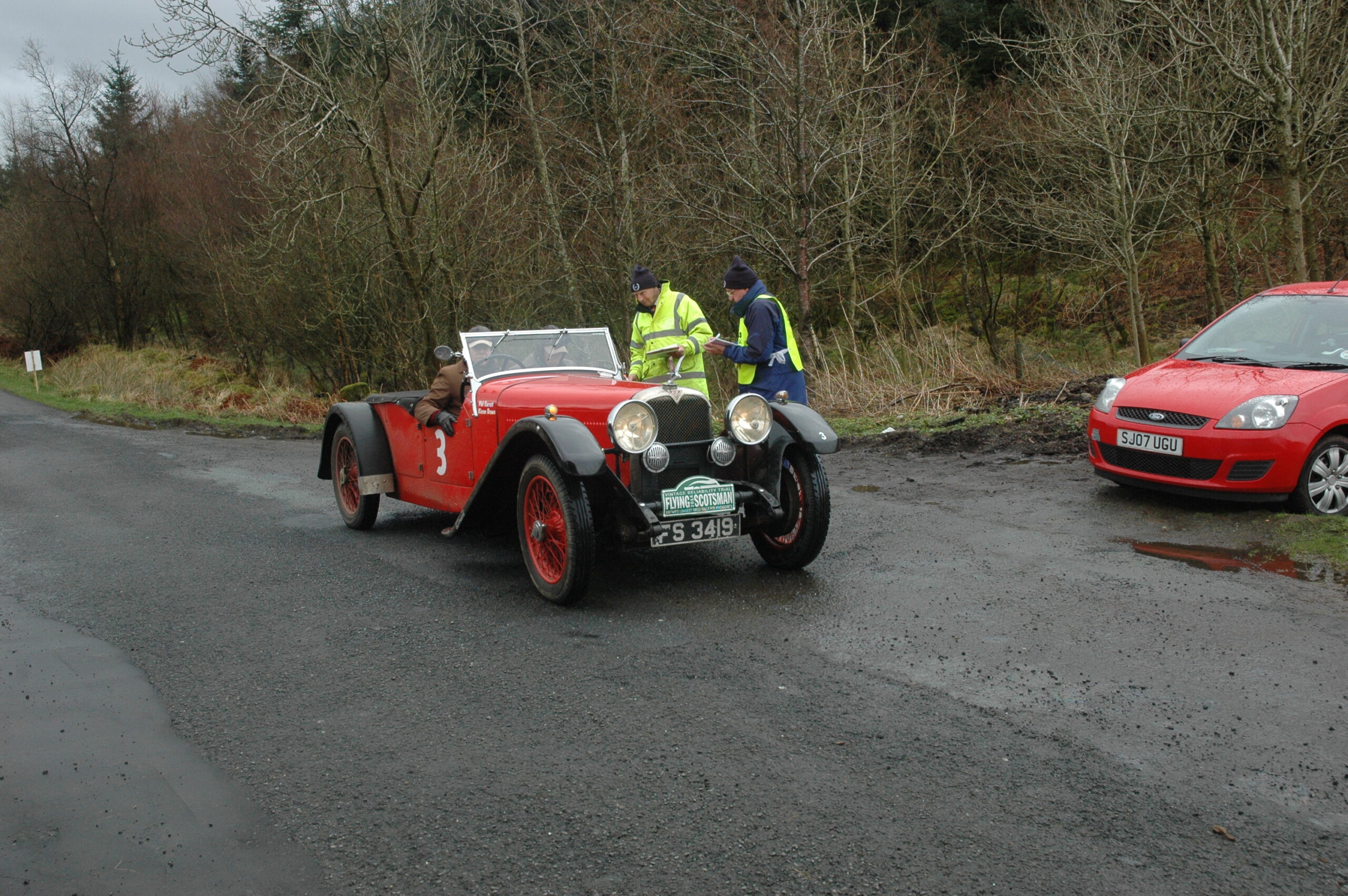


")